Most people don’t lose money in land because the land is “bad”. They lose money because they skip small legal checks in the beginning. A plot can look perfect on the site visit — open view, good road, nice surrounding — and still create trouble later if paperwork and permissions are not aligned.
An N.A. plot can be a sensible purchase when it is approached with discipline. This guide is written in simple language so a layman can understand what to check, where to check it, and what documents to demand before paying even one rupee.
No hype. No promises. No “best plot” talk. Only a clean checklist.
First, what does “N.A.” actually mean?
“N.A.” means Non-Agricultural. In Maharashtra, agricultural land is meant for farming use. When the land is permitted for non-farm use (like residential / commercial / industrial, depending on zoning), it is commonly referred to as N.A.
A very important point: N.A. is not a “magic stamp” that makes land automatically safe or ready. It is only one part of the legal framework. A land decision becomes safe when multiple checks align together — title, zoning, access, approvals, and clean documentation.
The biggest confusion: N.A. land vs plotted development
This is where many buyers get misled — not always intentionally, but because terms are used loosely.
1) Simple land sale: someone sells a single parcel as it is. No promised internal roads, no plotted layout, no “project” style commitments.
2) Plotted development: land is divided into multiple plots and sold with project-style representation: internal roads, drainage, street lights, amenities, security, compound, or “layout plan”.
Layman rule: if it is being sold like a layout/project, treat it like a project. This is where compliance, approvals, and (where applicable) project transparency become critical.
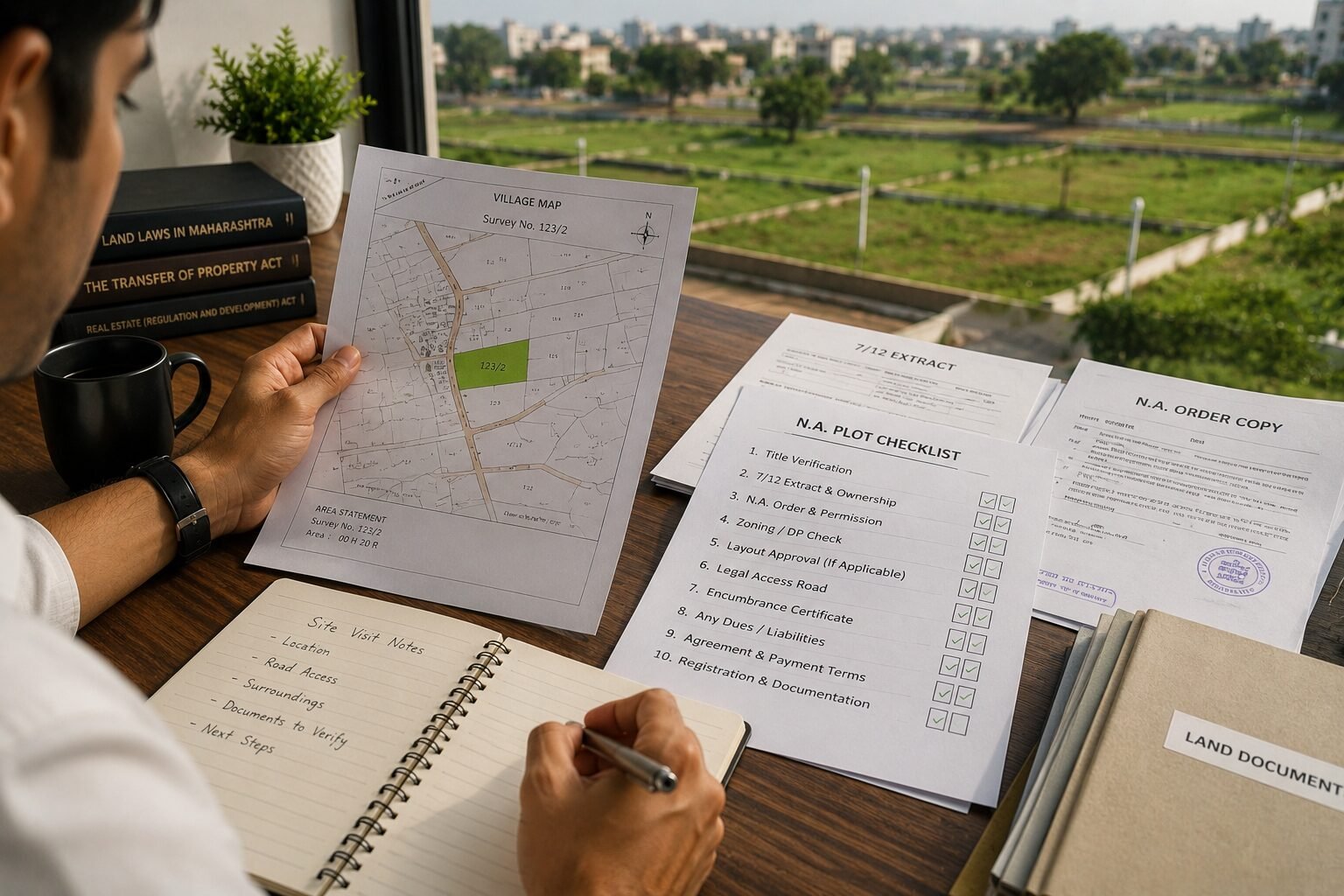
Your N.A. plot checklist (do this in order)
Step 1 — Ask for the exact survey / gut number first
Do not accept “near highway”, “near hotel”, “near temple”, “next to that society”. Ask for:
- Survey No / Gut No
- Village name
- Taluka
- District
Without these details, you cannot verify anything properly.
Step 2 — Verify who owns it today (ownership clarity)
You must confirm the seller is the legal owner and has the right to sell. In land, “family land” or “uncle’s land” talk creates confusion later.
What you check in simple terms:
- Owner name matches the seller
- Any co-owners exist (multiple names)
- Any remarks that hint at dispute/claim
If multiple owners exist, don’t proceed until it is clarified cleanly.
Step 3 — Check past registered history (to avoid hidden surprises)
One of the safest habits is checking past registered documents. This is where you catch “paper problems” early — before you pay.
What you want to see:
- Earlier transfers were properly registered
- No strange rapid re-sales that look like paper movement
- No missing links or confusing jumps in ownership
Step 4 — Confirm N.A. status with proof (not words)
When someone says “N.A.” your next question is: show me the document. Ask for documentary proof of:
- N.A. permission/order (copy)
- Purpose of N.A. (residential / commercial / industrial etc.)
N.A. in conversation is meaningless if paperwork is missing or unclear.
Step 5 — Check zoning / DP reality (what is actually allowed)
Even if land is N.A., zoning decides what can actually be done. Many “cheap deals” later become blocked because the buyer discovers the use they planned is not allowed, or reservations exist.
Basic checks:
- Is the intended use allowed in that zone?
- Is there any reservation (road widening, public use, amenity, utilities)?
Step 6 — Confirm legal access road (not just “there is a road”)
Access is not only physical — it must be legally recognised. A plot may look accessible today, but without clean access documentation, future disputes can arise.
Ask:
- Is the road public or private?
- Is approach road officially shown in records/layout?
- Does the access rely on someone else’s private land?
Step 7 — If it’s a layout/project, treat it like a project
If the offering includes plotted layout, internal roads, common areas, amenities, or future development representation, then you must treat it like a project. This means approvals and transparency matter, and the buyer should demand clean documentation.
A safe mindset:
- Ask for approvals and layout clarity
- Don’t rely on brochure sketches
- Verify what is approved vs what is promised
Step 8 — Check encumbrances / liabilities (loans / charges / disputes)
Before paying major money, confirm there is no hidden liability. The land should not be under loan charge, attachment, or ongoing dispute.
If any part feels unclear, pause. Unclear today becomes costly tomorrow.
Step 9 — Payment discipline (avoid token pressure)
The most common trap is urgency: “Give token today, price will increase tomorrow.” Land does not become safer because you paid faster.
Healthy practice:
- Token only after basic verification
- Major payment only when documents match
- Banking trail, not cash
Step 10 — Maintain your own “land file”
Make one folder (digital + paper) and keep everything together:
- Survey/Gut details
- NA order copy
- Zoning/DP note
- Layout approval (if applicable)
- Ownership chain summary
- Search notes / copies / screenshots
- Final registered documents
This single habit saves you from confusion years later.
The five mistakes buyers make most often
1) They verify only “N.A.” and skip title
Title is the base. Everything else sits on it.
2) They trust layout sketches without approval
A sketch is not an approval.
3) They ignore zoning/reservation
Later they learn “you can’t do what you planned”.
4) They assume access is fine because they can drive there
Legal access matters more than physical access.
5) They pay first, verify later
This single mistake creates most long disputes.
Calm closing note
Buying land is not about being brave. It is about being disciplined. If you slow down and verify properly, an N.A. plot can be a clean, practical asset to hold. If you rush, the same land can turn into paperwork stress for years.
The best land decision is the one that still feels clean and confident five years later.