
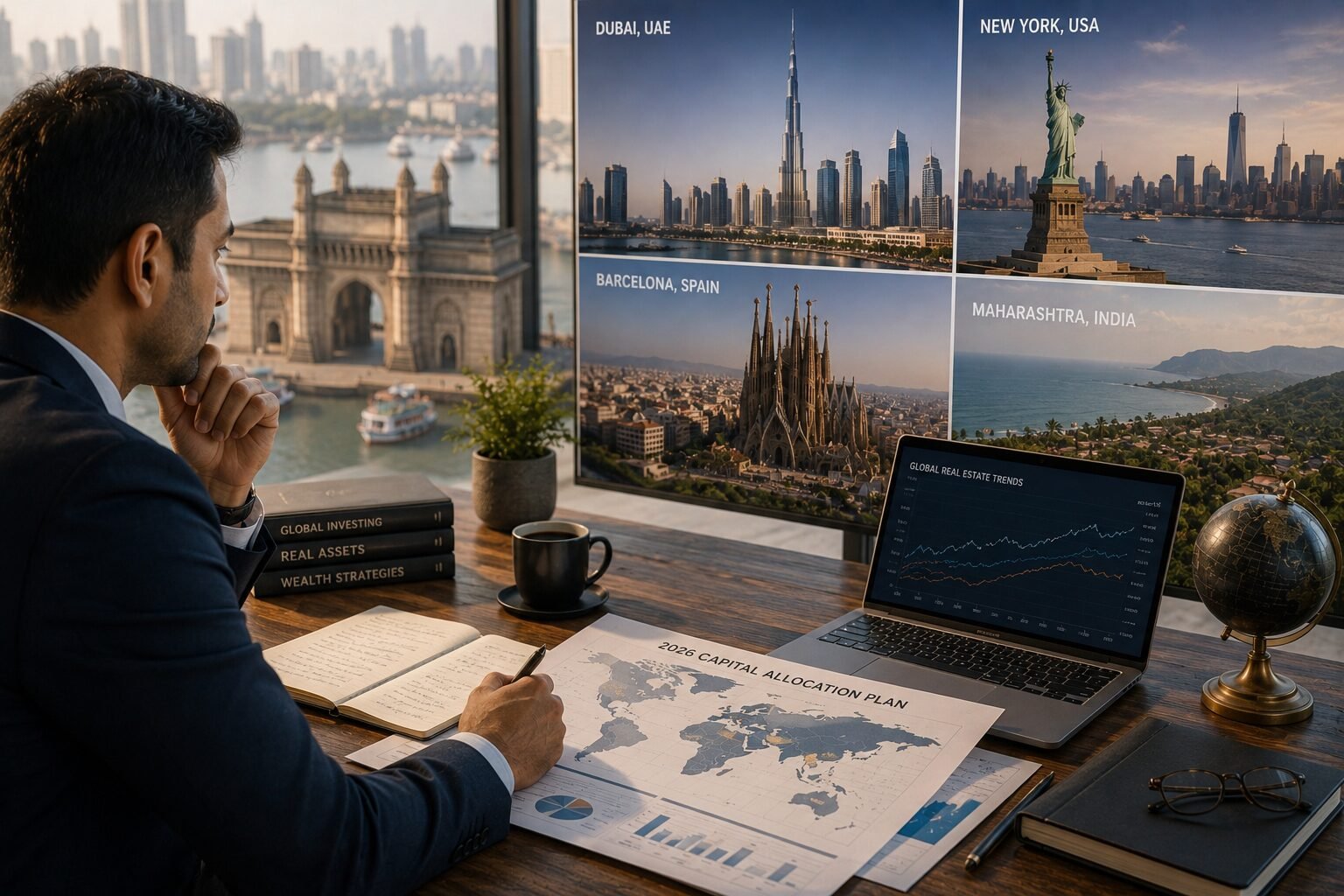
Executive Summary (read this first)
- 2026 is a decision window: infrastructure is turning “distance” into “minutes”.
- Serious money avoids hype: it chooses legality, liquidity, and exit visibility.
- NRIs should compare opportunity cost: staying liquid can quietly become a loss.
- Maharashtra’s edge: depth of market + demand maturity + regulatory structure (if used correctly).
- Global cities teach one lesson: predictable rules beat emotional buying.
- Rule of safety: buy only what you can verify and explain in one page to your family.
Quick Navigation
1) Who this guide is for 2) The simple decision framework 3) Part 1 — Economic arbitrage (USD vs INR reality) 4) Part 2 — Infrastructure as a multiplier (minutes matter) 5) Part 3 — Tax & compliance logic (risk reduction) 6) Part 4 — Micro-market thinking (how to compare belts) 7) Due diligence checklist (non-negotiables) 8) FAQ (most asked questions) 9) Closing perspective + next stepWho this guide is for
This is written for buyers who do not want to “hope” their way into a property decision. It is for NRIs, doctors, founders, IT professionals, senior executives, and families who want a clean, structured way to answer one question:
“If I am deploying serious money in 2026, what is the safest, most intelligent way to compare Maharashtra with global alternatives — without being manipulated by emotion or marketing?”
If you are looking for flashy claims, quick flips, or guaranteed returns, this article will feel slow. That is intentional. The buyers who end up happiest are rarely the ones who moved fastest. They are the ones who moved with clarity.
The simple decision framework (use this before looking at any property)
Before comparing Maharashtra vs Dubai vs USA vs Spain, compare the role of property in your life. For serious buyers, property is usually one of these:
- Capital preservation: “I want safety, legality, and long-term stability.”
- Usability + lifestyle: “I want a base in India or a place my family can actually use.”
- Legacy planning: “I want something that becomes family continuity, not family conflict.”
- Long-term growth: “I accept time, but only with rules and exit visibility.”
Once your “role” is clear, the comparison becomes easier. Global markets often look attractive from distance, but every geography has its own tax rules, holding friction, and behavioural risk. The goal is not to “win” an argument. The goal is to pick the safest path for your life, your family, and your money.
Part 1 — The Economic Arbitrage (why 2026 feels different)
In many NRI conversations, USD strength feels like a permanent advantage. It is an advantage — but only if you use it correctly. The hidden mistake is to assume that holding cash is “neutral”. Cash is not neutral. Cash is a position. And in 2026, the opportunity cost of staying liquid can be real.
If you are an NRI earning in USD (or a buyer holding large cash reserves), ask a simple question: what is my money doing while I wait? Waiting can be wise — but waiting without a framework becomes an expensive habit.
A clean way to think about it
- If cash is parked “until clarity”, define what clarity means (document, approvals, RERA, title, exit path).
- If cash is parked “until prices fall”, define the trigger (rate cuts, inventory, policy, cycle).
- If cash is parked “because I’m busy”, that is not strategy — that is risk postponed.
Maharashtra’s advantage in 2026 is not that it is “cheap”. It is that it is deep. Depth matters because depth creates liquidity. Liquidity creates exit visibility. And exit visibility is what turns a property into an asset instead of a story.
Part 2 — Infrastructure as a Multiplier (minutes matter more than announcements)
Most people misunderstand infrastructure. They think infrastructure is about maps. In reality, infrastructure is about behaviour. When behaviour changes, value changes.
In Maharashtra, the biggest value shifts happen when “distance” becomes “minutes” — and when daily usability becomes possible, not just weekend dreaming.
What to observe (not what to believe)
- 15–20 minute reality: Can a family realistically access healthcare, essentials, and connectivity?
- Consistency: Does the area work in monsoon, peak traffic, and normal weekdays?
- Absorption: Are people actually moving / renting / using the area, or only “visiting”?
Global cities teach one harsh lesson: once connectivity becomes stable, prices rarely “go back to old days”. They may pause. They may consolidate. But the base changes.
Part 3 — Tax & Compliance Logic (how serious money protects itself)
Serious buyers are not just buying “property”. They are buying a legal structure: ownership clarity, enforceable rights, and future transfer without drama.
This is why, in Maharashtra, the most important line is simple: Only consider MahaRERA-registered projects where applicable, and verify everything independently. This is not fear. This is intelligence.
Due diligence checklist (non-negotiables)
- MahaRERA verification: registration and approvals must be checked, not “told”.
- Title & encumbrance: clarity on ownership chain, loans, liens, disputes.
- Exact unit terms: carpet area definitions, possession clauses, penalty clauses.
- Bankability: lenders’ due diligence is a second layer of safety (not perfect, but useful).
- Exit logic: who is the future buyer for this ticket size and location?
Private note for NRIs
Most NRI mistakes are not about bad intent — they are about distance. If you want, message us on WhatsApp and we will share a one-page due diligence checklist that you can hand to your lawyer / CA before you even shortlist.
Part 4 — Micro-market thinking (how to compare belts without project names)
I am not naming projects here intentionally. Instead, use a clean comparison method. A micro-market is healthy when it has:
- Real end-use demand (not just investor rotation)
- Strong rental logic (even if you don’t rent, it proves utility)
- Exit buyer pool (the bigger the pool, the safer the asset)
- Regulatory clarity (paper should not “depend on someone’s promise”)
FAQ (the questions serious buyers actually ask)
1) Should I wait for prices to fall?
Waiting can be smart if you have a defined trigger. If you are “waiting emotionally”, you will lose time. A better approach: pick a micro-market, set a legal checklist, and deploy only when the checklist is satisfied.
2) Is Maharashtra safer than buying abroad?
“Safer” depends on your ability to verify and manage. Abroad has rule clarity, but also tax and management friction. Maharashtra has depth, but requires strict diligence. A safe decision is the one you can verify end-to-end.
3) What should trigger my WhatsApp call with you?
If you are ready to shortlist, want a due diligence checklist, or want a confidential briefing without project promotion, WhatsApp is the right next step.
Closing perspective
The purpose of this article is not to convince you to “buy now”. The purpose is to upgrade your decision-making so you never regret your purchase later.
If you want, message us on WhatsApp with one line: “Buying Property 2026 — I want the checklist.” We’ll share the checklist and ask 3–4 calm questions to understand your intent before any discussion.