
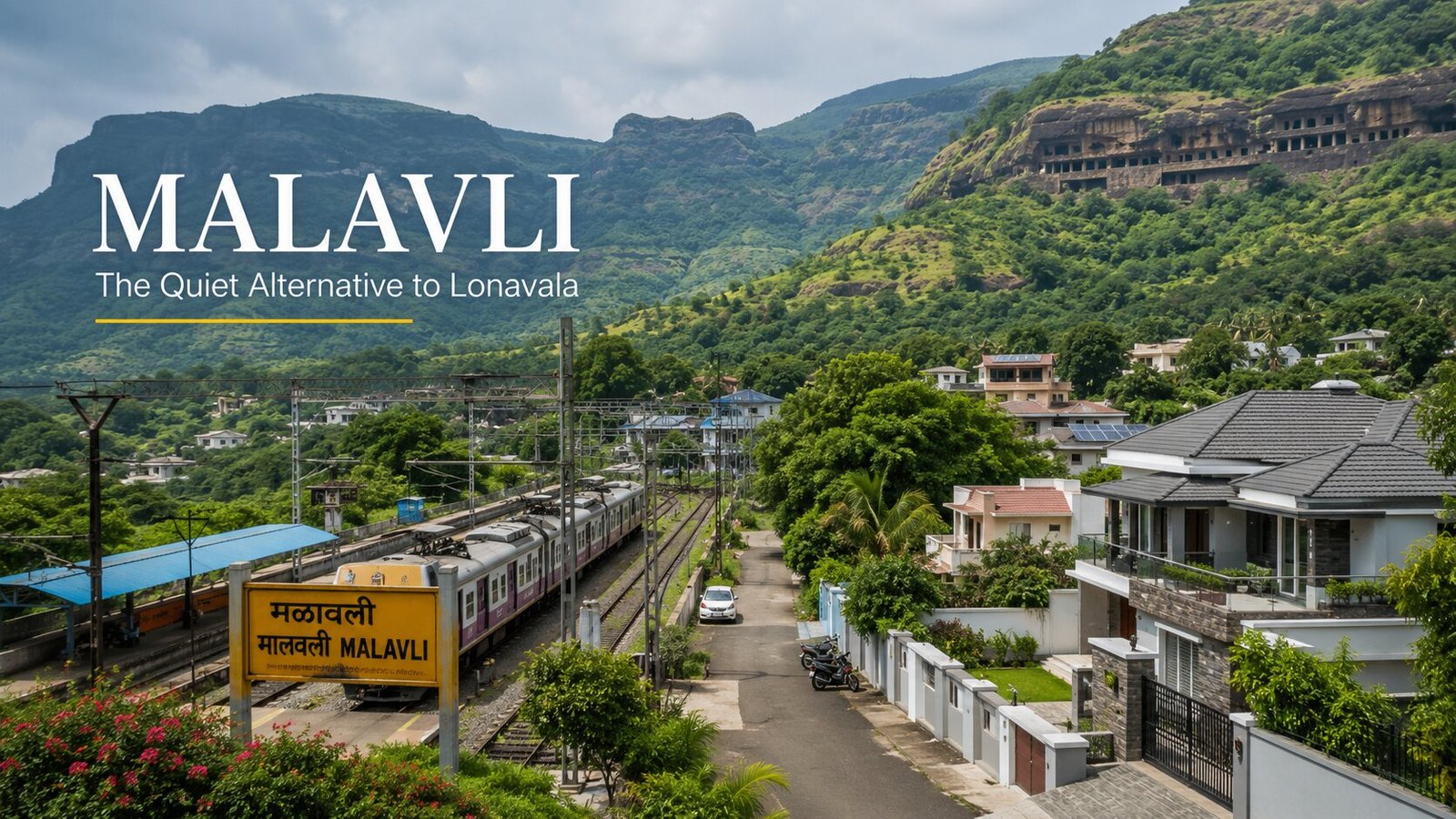
What Two Decades Around Malavli Have Taught Me About One of Maval's Most Discussed Locations
Whenever people discuss second homes, farmhouse plots, agricultural land or countryside living near Mumbai and Pune, Lonavala is usually one of the first locations that comes up in conversation. Over the years, it has become one of Maharashtra's most recognised hill destinations, attracting tourists, weekend travellers, corporate groups and property buyers alike.
However, during the last two decades, I have noticed something interesting. Many people who initially begin their search in Lonavala eventually start exploring nearby locations. Sometimes it is because they want more open spaces. Sometimes they prefer a quieter environment. Sometimes they simply want to understand what lies beyond the familiar tourist circuits.
One location that repeatedly comes up during these conversations is Malavli.
Situated in the Maval region and surrounded by some of the most recognised historical, spiritual and natural landmarks in western Maharashtra, Malavli occupies a unique position. It has its own identity, yet remains closely connected to everything people appreciate about Lonavala.
Over the last two decades, I have spent considerable time visiting Malavli across different seasons, observing how the region has evolved while continuing to retain much of its countryside character. I have seen the monsoon crowds heading towards Lohagad Fort. I have watched families travelling for darshan at Ekvira Devi Temple. I have observed visitors arriving by train, road and expressway. I have also witnessed growing interest from people exploring agricultural land, NA plots and second-home opportunities across the wider Maval belt.
This article is not intended to promote any particular property. Instead, it is meant to help readers understand Malavli from a practical perspective based on local observations, regional understanding and real-world conversations with buyers over many years.
If you are considering land near Lonavala, researching the Maval region, exploring farmhouse opportunities or simply trying to understand whether Malavli deserves your attention, this guide may help you see the location beyond brochures and advertisements.
Where Exactly Is Malavli?
One of the reasons Malavli attracts attention is its accessibility.
Located in the Maval Taluka of Pune district, Malavli sits within a well-connected corridor between Mumbai and Pune. While many people recognise it as a railway stop on the Mumbai-Pune route, the area offers multiple access options that make it convenient for weekend visits and regular travel.
The Malavli Railway Station provides connectivity through the suburban and regional railway network, making the location familiar to thousands of commuters and visitors throughout the year.
Road connectivity is equally important.
The Mumbai-Pune Expressway has significantly improved access to the region, reducing travel time for visitors travelling from both metropolitan cities. Equally relevant is the Old Mumbai-Pune Highway, which continues to serve as a preferred route for many travellers who enjoy the scenic drive through the Sahyadris and wish to avoid the faster expressway environment.
This dual connectivity creates flexibility.
Whether someone is travelling from Mumbai, Navi Mumbai, Thane, Pune or Pimpri-Chinchwad, reaching Malavli is generally straightforward.
What often surprises first-time visitors is how quickly the environment changes. Within a relatively short distance, urban landscapes begin giving way to hills, open spaces, historic sites and countryside surroundings.
For people considering agricultural land, second homes or weekend retreats, this balance between accessibility and environment is often one of the region's strongest characteristics.
Why So Many People Continue Visiting This Region Throughout The Year
Unlike some locations that depend heavily on a single tourist season, the Malavli region remains active throughout the year for different reasons.
Nature enthusiasts arrive during the monsoon.
Trekkers visit the forts.
Families come during school holidays.
Spiritual visitors travel for darshan.
Weekend travellers book private bungalows and farm stays.
The result is a location that remains relevant across seasons rather than being dependent on a single attraction.
The region also attracts visitors seeking short breaks from urban life. The combination of hills, greenery, historical landmarks and relatively easy accessibility creates a natural appeal for people looking to disconnect from city routines.
In recent years, another trend has become increasingly visible.
Many successful professionals, business owners and families prefer private bungalow stays rather than crowded hotel environments. The wider Maval belt has seen growing interest from individuals who value privacy, open spaces and nature-oriented weekend experiences.
This does not mean the region has become exclusively luxury-focused.
Rather, it reflects the fact that different types of visitors are discovering different aspects of the area.
Some come for trekking.
Some come for spirituality.
Some come for relaxation.
Some come simply to spend time with family in a quieter environment.
This diversity contributes significantly to the identity of Malavli and its surrounding villages.
Ekvira Temple, Karla Caves and MTDC Karla
It would be difficult to discuss Malavli without mentioning the spiritual and historical significance of the surrounding region.
One of the most recognised landmarks is Ekvira Devi Temple.
Located near the famous Karla Caves, the temple attracts devotees from across Maharashtra throughout the year. During festive periods and weekends, thousands of visitors travel to the area for darshan.
For many families, a visit to Ekvira Devi Temple is not merely a religious journey. It often becomes a day trip that includes exploring nearby attractions and spending time within the larger Maval landscape.
Adjacent to the temple are the renowned Karla Caves.
These ancient Buddhist rock-cut caves are among the most important historical sites in Maharashtra and continue to attract visitors interested in archaeology, architecture and heritage.
The presence of MTDC Karla has further contributed to the visibility of the area, helping travellers discover nearby destinations across the region.
Together, Ekvira Temple, Karla Caves, Bhaje Caves and MTDC Karla form an important part of the identity of this belt. These landmarks attract devotees, history enthusiasts, trekkers and families throughout the year, helping introduce many first-time visitors to the wider Maval region.
Many people first visit for spiritual or historical reasons and later develop a deeper appreciation for the surrounding countryside, forts and villages.
Their first introduction may be tourism.
Their second visit may be curiosity.
Their third visit often involves exploring the wider region in greater detail.
This pattern is something I have personally observed numerous times over the years.
Lohagad Fort, Visapur Fort and the Identity of Malavli
Ask ten people what first comes to mind when they hear the name Malavli and there is a good chance that at least a few of them will mention Lohagad Fort.
Standing prominently above the region, Lohagad is one of the most visited forts in Maharashtra. Throughout the year, visitors of different age groups travel to the area to experience its history, views and trekking routes.
During the monsoon season, the fort becomes particularly popular. The surrounding landscape transforms into a sea of green, clouds roll across the hills and the entire region takes on a dramatically different appearance.
Closely associated with Lohagad is Visapur Fort.
While Lohagad generally attracts a larger number of casual visitors, Visapur often appeals to trekking enthusiasts who enjoy exploring less crowded routes and wider fort complexes.
Together, these two forts have played a major role in shaping the identity of the region.
For many people, their first visit to Malavli begins with a trek.
For others, it begins with a family outing.
Regardless of the reason, the forts help introduce visitors to the wider Maval landscape and often encourage them to explore further.
One interesting observation over the years is that many people who initially visit for tourism later return to experience the region differently.
Instead of rushing through a day trip, they begin spending weekends.
Instead of hotels, they explore private bungalows.
Instead of simply visiting, they start understanding the character of the surrounding villages.
This gradual transition is something that has become increasingly visible across the wider Maval belt.
Malavli vs Lonavala: Similar Environment, Different Experience
One question that often comes up is:
"Why should someone consider Malavli when Lonavala is already so well known?"
The answer is not that one location is better than the other.
The answer is that they offer different experiences.
Lonavala is one of Maharashtra's most established hill destinations. It has developed extensive hospitality infrastructure, restaurants, hotels, resorts and commercial activity.
Its popularity is understandable.
At the same time, that popularity has also resulted in increased traffic, heavier crowds during weekends and a more commercial atmosphere in many areas.
Malavli offers a different experience.
What surprises many first-time visitors is that they do not feel disconnected from the Lonavala environment.
The weather is similar.
The Sahyadri landscape is similar.
The greenery is similar.
The monsoon experience is similar.
The accessibility is similar.
The historical attractions are nearby.
The spiritual landmarks are nearby.
The difference is often found in the pace of life.
Many parts of Malavli continue to retain a countryside character that some visitors find appealing.
Instead of busy commercial stretches, one encounters village roads, open fields, hills and natural surroundings.
For buyers exploring second homes, agricultural land or weekend retreats, this distinction can be important.
Some people genuinely enjoy the energy of Lonavala.
Others prefer a slightly quieter environment while still remaining close to everything the region has to offer.
In many cases, visitors discover that they are not sacrificing the broader Lonavala experience.
They are simply experiencing a different side of the same landscape.
Malavli Through Summer, Monsoon and Winter
Every location changes throughout the year.
Malavli is no exception.
Understanding the seasonal character of a place is important, particularly for anyone considering a second home or regular visits.
Summer
During summer, temperatures naturally rise across the region.
However, compared with dense urban environments, many visitors appreciate the open surroundings and airflow associated with the Sahyadri landscape.
Summer also remains a popular period for private bungalow stays and family getaways.
School holidays contribute to increased visitor movement, particularly among families travelling from Mumbai and Pune.
Monsoon
For many people, monsoon is when Malavli is at its most dramatic.
The hills become intensely green.
Streams and waterfalls appear throughout the region.
Clouds move across the valleys.
The forts attract thousands of trekking enthusiasts.
The atmosphere changes completely.
This seasonal transformation is one of the reasons why the wider Maval belt remains so popular among nature lovers.
Winter
Winter often brings pleasant weather and comfortable outdoor conditions.
This is a period when many visitors enjoy spending time outdoors, exploring historical sites, trekking routes and countryside locations.
For people considering weekend homes or regular visits, winter provides an opportunity to experience the region at a slower pace.
Each season reveals a different aspect of Malavli.
That seasonal variety is one of the reasons why people continue returning year after year.
Why Successful Professionals and Families Are Drawn to the Region
Another noticeable trend over the years has been the growing interest in private spaces.
Many professionals today spend most of their time in fast-moving urban environments.
Long working hours, traffic and constant connectivity have increased the appeal of locations that offer a different atmosphere during weekends.
The wider Malavli and Maval region has benefited from this shift.
Private bungalows, farm stays and countryside retreats have become increasingly popular among families seeking privacy and open spaces.
This does not mean everyone is purchasing property.
Many people simply enjoy spending time in the area before considering any long-term decisions.
However, it has contributed to a broader awareness of the region.
What often attracts people is not luxury in the conventional sense.
It is the opportunity to spend time in a landscape that feels less crowded and more connected to nature.
For some, that means occasional weekend visits.
For others, it eventually leads to exploring agricultural land, second homes or long-term countryside living options.
What Continues To Bring Me Back To Malavli
After spending time around the region over two decades, there are several things that continue to stand out.
The first is balance.
Malavli is accessible without feeling overly urban.
It is connected without feeling isolated.
It offers historical attractions without becoming entirely dependent on tourism.
The second is variety.
Within a relatively small area, one can experience forts, caves, spiritual landmarks, countryside landscapes and village environments.
The third is familiarity.
Many people visit once and return repeatedly.
There is something about the region that encourages exploration beyond a single trip.
For some people it is the forts.
For others it is the climate.
For others it is simply the opportunity to spend time away from city routines.
Whatever the reason, the region has managed to retain an identity that extends beyond individual attractions.
That identity is difficult to explain through photographs alone.
It is usually understood after spending time there.
A Reality Check Before Looking at Land
One important observation I would like to share is this:
Many people fall in love with a location before understanding the practical realities of land ownership.
Beautiful views are important.
Pleasant weather is important.
Natural surroundings are important.
But when evaluating land, documentation, zoning, access roads and legal clarity become equally important.
A great location does not automatically mean every parcel within that location is suitable.
That is why understanding the ground reality is often more valuable than simply looking at photographs or online listings.
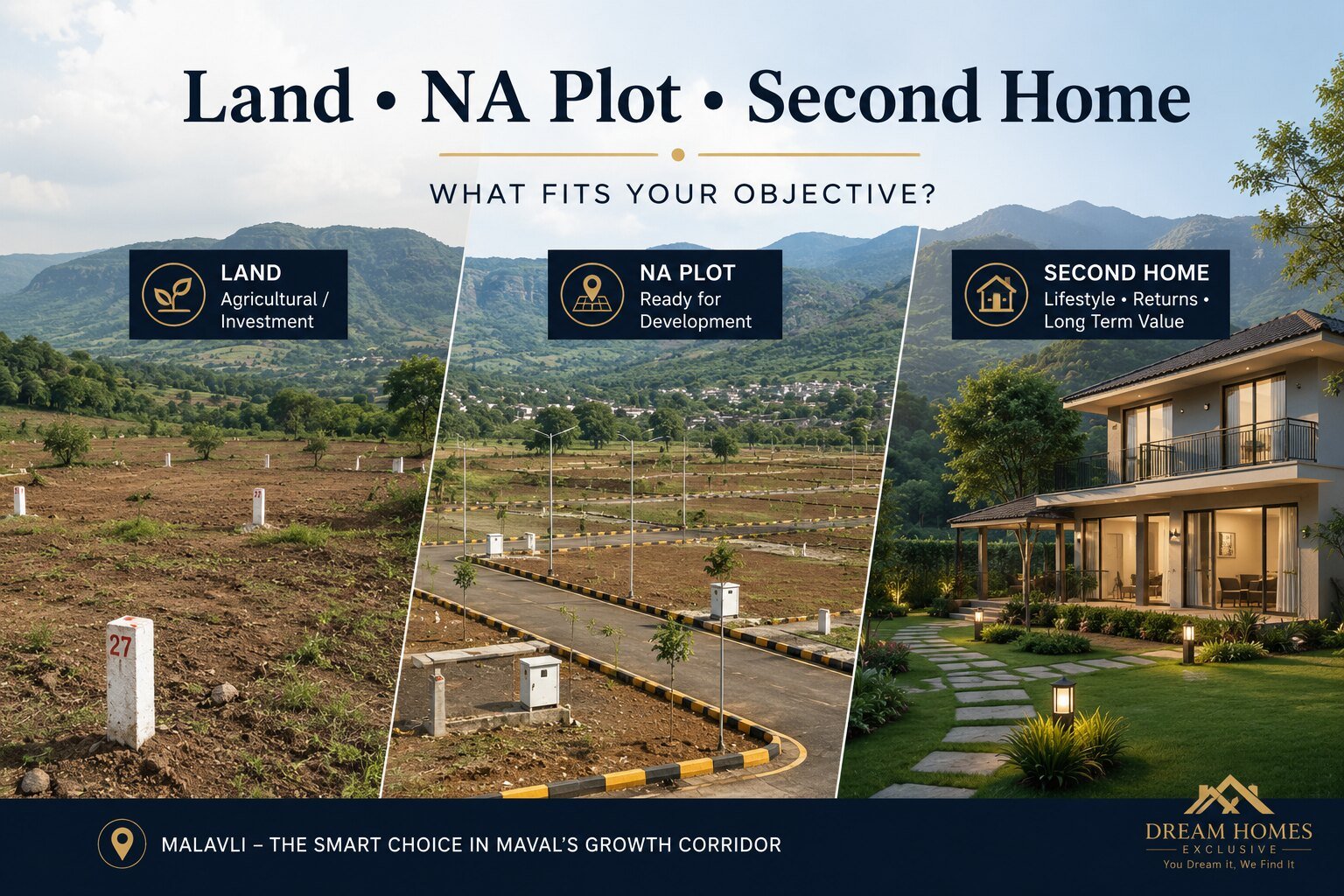
Agricultural Land, NA Plots and Second Homes: Understanding the Difference
One of the most common mistakes I see is that people use the words land, plot, NA plot and agricultural land interchangeably.
In reality, these are very different categories.
Before making any buying decision in Malavli, Lonavala or anywhere across the Maval region, understanding these differences is essential.
Agricultural Land
Agricultural land remains one of the most common forms of land ownership in the villages surrounding Malavli.
These parcels are traditionally used for farming and agricultural activities.
Many buyers are attracted to agricultural land because of larger parcel sizes, open surroundings and countryside settings.
However, buyers should never assume that agricultural land automatically allows every type of development.
Before purchasing agricultural land, it is important to understand:
- Current zoning
- Existing usage
- Access rights
- Documentation
- Local regulations
Every parcel is different.
What applies to one property may not apply to another.
NA Plots
NA stands for Non-Agricultural land.
These plots fall under a different category and often attract buyers looking for residential or second-home opportunities.
However, one of the biggest misconceptions in the market is that every plot being advertised as "NA" has been properly verified.
Documentation should always be independently checked.
Never rely solely on marketing material or verbal statements.
Second Homes
The second-home segment has become increasingly visible across the wider Maval region.
Many families today are looking for locations where they can spend weekends, holidays or extended periods away from urban environments.
Some prefer independent bungalows.
Some prefer managed developments.
Others simply purchase land and postpone construction until later.
The right choice depends entirely on individual goals, budgets and lifestyle preferences.
Understanding Land Values Around Malavli
One question that naturally arises during property discussions is:
"What is the current land rate?"
The reality is that there is no single answer.
Unlike apartments in a specific building, land values can vary significantly within a relatively short distance.
Factors that influence land value include:
- Location
- Zoning
- Road access
- Topography
- Water availability
- Documentation
- Parcel size
- Views
- Nearby development
In practical terms, agricultural land transactions in and around the region may vary considerably depending on these factors.
Two parcels located within the same village can have very different values.
This is why serious buyers should evaluate individual properties rather than relying on a generic "market rate."
Understanding Zones Before Buying
If there is one topic that deserves more attention among buyers, it is zoning.
Many people focus entirely on price and location while paying very little attention to the land's actual classification.
This can create significant confusion later.
Agricultural Zone
Agricultural zones are intended primarily for agricultural purposes.
Before purchasing such land, buyers should understand exactly what the applicable rules and limitations are.
Assumptions can be expensive.
Verification is always preferable.
R Zone
R Zone land often attracts attention because of its potential residential relevance.
However, buyers should still verify all applicable regulations, permissions and planning considerations.
Never assume that all R Zone properties are identical.
NA Land
As discussed earlier, NA land falls into a different category.
Documentation should be reviewed carefully before any commitments are made.
Why Zoning Matters
Zoning influences:
- Land use
- Development possibilities
- Future flexibility
- Documentation requirements
A beautiful parcel with incorrect assumptions can become a source of frustration later.
A properly understood parcel usually creates far fewer surprises.
Common Mistakes Buyers Make
After observing numerous transactions and buyer journeys over the years, several recurring mistakes stand out.
Mistake 1: Falling in Love With the View
Beautiful views are attractive.
However, buyers should never evaluate land based solely on scenery.
Documentation matters.
Access matters.
Zoning matters.
Road connectivity matters.
Mistake 2: Believing Every Verbal Promise
Statements such as:
"Road will come soon."
"NA will happen soon."
"Big project is coming nearby."
"Everyone is buying here."
should always be supported by proper documentation and independent verification.
Hope is not documentation.
Mistake 3: Ignoring Access Roads
One of the most overlooked aspects of land buying is legal and practical access.
Before committing to any property, buyers should understand how the parcel is accessed and whether those access arrangements are properly documented.
Mistake 4: Assuming Every Agricultural Parcel Is the Same
Agricultural land varies enormously.
Slope, water, approach roads, location and documentation can make substantial differences.
Mistake 5: Rushing the Process
Excitement often leads people to move too quickly.
Land purchases deserve patience.
Taking extra time for verification is usually far better than rushing into avoidable problems.
Why Buyers Should Never Depend Solely on Outsiders
This point deserves special attention.
Many buyers enter unfamiliar locations with very limited local knowledge.
As a result, they often depend entirely on brokers, intermediaries or third parties.
There is nothing wrong with taking guidance.
The problem arises when guidance replaces verification.
No matter who introduces a property:
- Verify documents.
- Verify zoning.
- Verify access.
- Verify ownership.
- Verify claims.
A healthy amount of due diligence protects both time and capital.
The goal is not to distrust everyone.
The goal is to ensure that important decisions are supported by facts rather than assumptions.
Questions I Would Ask Before Buying Any Land in Malavli
Before purchasing agricultural land, NA plots or second-home land, I would personally want clear answers to the following questions:
- What is the exact zoning?
- Is the title history clear?
- Is the approach road legally accessible?
- What is the water situation?
- Have all documents been independently verified?
- What assumptions am I making that still need confirmation?
These questions may appear simple, but they often reveal important details that buyers might otherwise overlook.
Final Thoughts
Malavli occupies a unique position within the wider Maval region.
It benefits from proximity to Lonavala while maintaining much of its own identity.
The presence of Lohagad Fort, Visapur Fort, Ekvira Temple, Karla Caves, Bhaje Caves and the surrounding Sahyadri landscape ensures that the region remains familiar to visitors throughout the year.
At the same time, the countryside character of many areas continues to appeal to families, nature lovers and individuals seeking a different pace of life.
For those exploring agricultural land, NA plots or second-home opportunities, the most important lesson is this:
Do not make decisions based solely on location names.
Understand the land.
Understand the documentation.
Understand the zoning.
Understand the ground reality.
A good decision is usually the result of careful evaluation rather than excitement.
Need Guidance on Land in Malavli, Lonavala or the Wider Maval Region?
Dream Homes By Rahul Gargatte works with buyers, investors and NRIs who are exploring agricultural land, NA plots, second homes and countryside opportunities across Maharashtra.
Whether you are evaluating a specific parcel, comparing locations or simply trying to understand the practical realities of a region before making a decision, informed guidance can often save considerable time and effort.
Every property is different.
Every location has its own realities.
The key is understanding them before committing to a purchase.
Before you buy, understand the ground reality.
That single step can make all the difference.