
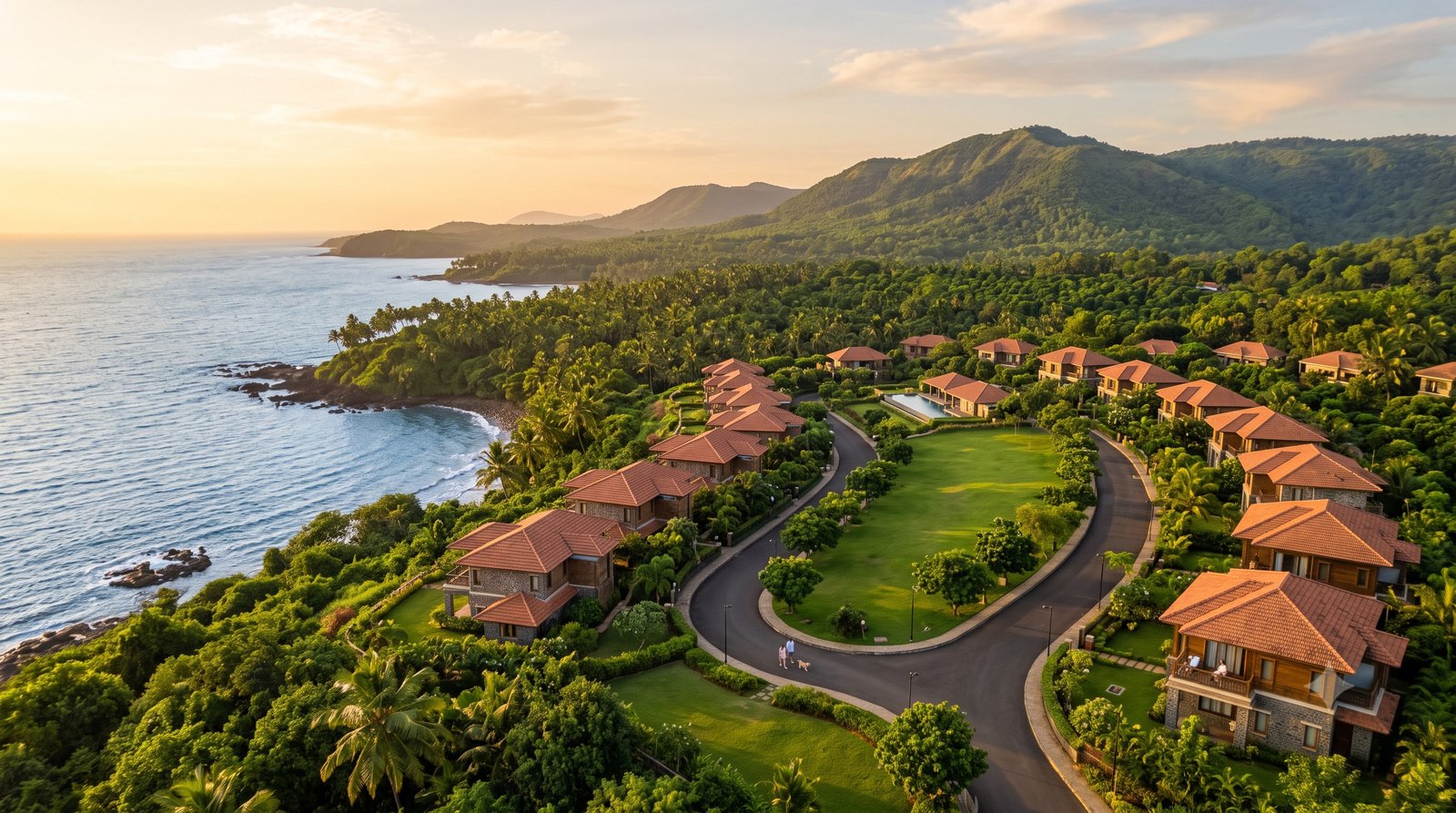
Why Are More Buyers Suddenly Talking About Ratnagiri?
Whenever the subject of second homes comes up, the same destinations usually dominate the conversation.
Lonavala.
Alibaug.
Karjat.
Goa.
Sometimes Dapoli.
These places have built their reputation over many years and continue to attract thousands of buyers every year.
Yet, over the last few years, another name has quietly started appearing in these discussions.
Ratnagiri.
Interestingly, Ratnagiri itself is not new.
Generations of families across Maharashtra have travelled here.
Many associate the district with world-famous Alphonso mangoes.
Others immediately think about Ganpatipule.
Some remember long drives through the Konkan.
For many people, Ratnagiri has always been a holiday destination.
Very few looked at it from the perspective of owning property.
That conversation is slowly changing.
Not because someone has declared Ratnagiri to be the "next Goa."
Not because advertisements are promising unbelievable appreciation.
The reason is much simpler.
People themselves have changed.
The way people think about property has changed.
Earlier, buying a second home usually meant owning a place that remained locked for most of the year.
Today, people expect much more.
Some want a weekend home.
Some are planning early retirement.
Some business owners want a peaceful place where they can work remotely for a few days every month.
Others simply want their children to grow up experiencing nature rather than spending every holiday inside shopping malls.
These changing lifestyles are encouraging buyers to explore destinations they may never have seriously considered before.
Ratnagiri is one of those destinations.
Does that automatically mean every property in Ratnagiri is worth buying?
Absolutely not.
Like every district in Maharashtra, Ratnagiri has excellent locations.
It also has locations that may not suit every buyer.
Understanding the difference is far more important than following market trends.
That is exactly why this guide has been written.
Not to convince you.
But to help you understand Ratnagiri from the perspective of a careful property buyer.
Ratnagiri Has Always Had An Economy Beyond Tourism
One of the biggest misconceptions about Ratnagiri is that it survives only because of tourism.
That is simply not true.
Tourism certainly contributes to the district.
Visitors travel throughout the year to destinations like Ganpatipule, Ratnadurg Fort, Jaigad, Aare-Ware Beach and several other coastal locations.
Hotels, restaurants, transport operators and local businesses all benefit from tourism.
However, tourism is only one part of Ratnagiri's identity.
Agriculture continues to be one of the district's strongest economic pillars.
Across India, Ratnagiri enjoys worldwide recognition because of the Ratnagiri Alphonso (Hapus) Mango, which has received a Geographical Indication (GI) Tag, recognising its unique origin and characteristics. Every summer, thousands of tonnes of Alphonso mangoes are transported to markets across India and overseas, supporting farmers, traders, transporters and export businesses.
Alongside mango cultivation, cashew plantations, coconut farming and horticulture continue to provide livelihoods across many parts of the district.
Fishing remains another major occupation.
Several coastal villages have depended on fishing for generations, supplying seafood to regional and national markets.
Small businesses, education, government services and local commerce together create a district that functions throughout the year—not just during the holiday season.
Why is this important for property buyers?
Because sustainable property markets are generally supported by locations where people actually live, work and conduct business.
Buying property is very different from buying a holiday.
Understanding how a district functions economically provides valuable context before making any long-term decision.
Looking Beyond Tourism
Many people first discover Ratnagiri while travelling.
Perhaps during a family holiday.
Perhaps while visiting Ganpatipule.
Perhaps while driving along the Konkan coast.
The first visit usually focuses on beaches.
Food.
Temples.
Scenery.
The second visit is often different.
People begin driving through nearby villages.
They notice schools.
Hospitals.
Markets.
Residential areas.
Agricultural land.
They begin asking practical questions.
Could I spend weekends here?
Would my parents enjoy retirement here?
Is this somewhere my children would actually like visiting every holiday?
Could this become a long-term family asset?
This is where tourism slowly transforms into property exploration.
The two should never be confused.
A wonderful holiday does not automatically make a location suitable for ownership.
Likewise, a quieter village that receives fewer tourists may turn out to be an excellent place for someone seeking peace, privacy and long-term lifestyle value.
That is why buyers should never judge a location after a single weekend.
Spend time there.
Talk to local residents.
Visit during different seasons.
Understand everyday life.
Property decisions deserve that level of patience.
Why Many Buyers Are Looking At Second Homes Differently
The meaning of a second home has changed considerably over the last decade.
Earlier, many families bought holiday homes that remained unused for most of the year.
Today, people expect much more from a second property.
Some spend long weekends away from the city almost every month.
Others divide their time between two homes.
Many professionals work remotely for several days each month.
Retired couples often prefer quieter surroundings without giving up access to larger cities whenever required.
In this changing environment, locations like Ratnagiri naturally begin attracting attention.
Not because they promise quick profits.
But because they offer something many cities cannot.
Space.
Cleaner surroundings.
A slower pace of life.
Access to nature.
A strong cultural identity.
Of course, every buyer's priorities are different.
Someone looking for nightlife, luxury shopping or high-density urban living may not find Ratnagiri suitable.
On the other hand, buyers seeking peace, coastal surroundings and a long-term lifestyle property may appreciate exactly those qualities.
Neither preference is right or wrong.
The important thing is choosing a location that genuinely matches your lifestyle rather than simply following market popularity.
Is Ratnagiri Suitable For Retirement?
This is another question I hear quite often.
There is no universal answer.
For some people, Ratnagiri may be an excellent retirement destination.
For others, another location may be more practical.
Retirement is no longer just about leaving work.
It is about choosing how you want to spend the next twenty or thirty years of your life.
Some people dream of quieter mornings.
Fresh air.
Walking along the coastline.
Gardening.
Reading.
Spending time with grandchildren during school holidays.
Others prefer remaining close to metropolitan hospitals, airports and busy commercial centres.
Again, neither choice is wrong.
If Ratnagiri is being considered for retirement, I would strongly recommend spending extended time there before making a purchase.
Visit during summer.
Visit during the monsoon.
Experience everyday life rather than only holiday periods.
Retirement is about comfort.
That comfort comes from understanding the location—not from rushing into a purchase.
Connectivity Has Changed The Way Buyers Look At Ratnagiri
Whenever a new destination starts appearing in property discussions, one factor almost always plays an important role.
Connectivity.
People may fall in love with a location because of its natural beauty, but they eventually decide whether it is practical based on how easily they can reach it.
Ratnagiri has benefited from steady improvements in connectivity over the years.
Although it still retains its peaceful Konkan character, reaching the district today is considerably easier than it once was.
For families travelling from Mumbai, Navi Mumbai, Thane, Pune and neighbouring cities, this has made weekend travel much more practical than many people realise.
One of the biggest contributors has undoubtedly been the Konkan Railway.
The Konkan Railway Changed More Than Just Travel
When the Konkan Railway became operational, it transformed travel along India's western coastline.
Places that once required long and tiring journeys suddenly became much easier to access.
Today, Ratnagiri Railway Station connects the district with Mumbai, Goa, Mangaluru and several important cities along the Konkan route.
For tourists, that means convenience.
For residents, it provides an important transport lifeline.
For second-home buyers, however, it offers something equally valuable.
Accessibility.
A property that can be comfortably reached is naturally more likely to be used regularly.
Weekend homes only make sense when travelling does not become an exhausting exercise every time.
That does not mean railway connectivity automatically increases property prices.
It simply makes ownership more practical.
Road Infrastructure Continues To Improve
Road travel has also changed significantly.
National Highway 66, formerly known as NH-17, remains one of India's most important coastal highways, connecting Mumbai with Goa through the Konkan region.
Different stretches have been widened and upgraded over the years, while work continues in several sections.
These improvements have gradually reduced travel challenges for many commuters and visitors.
For buyers, improved roads certainly deserve attention.
However, I would also advise caution.
One mistake often made in real estate is assuming that every infrastructure project automatically results in higher property values.
That assumption is neither fair nor accurate.
Infrastructure certainly influences buyer interest.
But appreciation depends on far more than roads alone.
Legal documentation.
Location.
Neighbourhood.
Access roads.
Utilities.
Surrounding development.
Demand and supply.
These factors continue to play an equally important role.
Whenever someone says,
"Buy here because the highway is coming."
my first response would be,
"Let's first understand the property itself."
Infrastructure supports development.
It should never replace due diligence.
Does Better Connectivity Mean Better Investment Potential?
This is perhaps one of the most frequently asked questions.
The honest answer is that nobody can guarantee future appreciation.
History certainly shows that infrastructure has influenced buyer demand in many parts of India.
Better roads often improve accessibility.
Improved accessibility may encourage tourism.
Businesses may expand.
Travel becomes easier.
People become more familiar with the region.
All these factors may positively influence long-term interest.
However, property appreciation depends on multiple factors working together.
Government infrastructure alone is not enough.
Likewise, buying property only because someone predicts future appreciation is rarely a wise strategy.
Personally, I believe buyers should focus first on purchasing a property that they would genuinely enjoy owning.
If appreciation follows over time, that becomes an additional benefit rather than the only objective.
Ratnagiri's Future Will Depend On More Than Tourism
One encouraging aspect of Ratnagiri is that its economy is supported by multiple sectors rather than a single industry.
Tourism is certainly important.
But so are agriculture, horticulture, fisheries, local businesses, education and public services.
The district's internationally recognised Alphonso mango industry continues to support thousands of farmers and associated businesses.
Fishing remains an important source of livelihood for many coastal communities.
Cashew processing, coconut cultivation and small-scale industries also contribute to the local economy.
This diversified economic base is one of the reasons Ratnagiri has maintained its identity beyond being merely a holiday destination.
As connectivity improves and awareness grows, more buyers may naturally begin exploring the district.
Whether that eventually translates into sustained property demand will depend upon several factors, including infrastructure completion, local planning, environmental regulations, buyer confidence and overall economic conditions.
No one can predict those outcomes with certainty.
Can Ratnagiri Be A Good Work-From-Home Destination?
This is a question that simply did not exist a decade ago.
Today, it is one of the first questions many professionals ask.
The answer depends on expectations.
Several parts of Ratnagiri now have reliable mobile connectivity and internet services, making short work-from-home stays possible.
However, buyers should never assume that every village offers the same level of digital infrastructure.
Network quality, broadband availability and service reliability may differ from one location to another.
If working remotely is an important reason for purchasing property, test the internet personally before making a decision.
Do not rely solely on assumptions or promotional claims.
A simple speed test during your visit can provide more confidence than any advertisement.
Healthcare And Education Also Matter
Sometimes buyers become so focused on the property itself that they forget to evaluate the surrounding ecosystem.
Questions worth asking include:
- Where is the nearest multi-speciality hospital?
- How far is the nearest primary healthcare centre?
- Are pharmacies easily accessible?
- Which schools and colleges are nearby?
- How long does emergency medical assistance take to reach the property?
These questions become especially important for families and retired couples.
Fortunately, Ratnagiri city and several important towns offer healthcare facilities, educational institutions, banks, government offices and other essential services.
However, the level of access naturally varies depending on the exact location of the property.
This is another reason why every property should be evaluated individually rather than making assumptions about the district as a whole.
A Second Home Should Improve Your Lifestyle
People often ask me,
"What should be the biggest reason for buying a second home?"
My answer is always the same.
Lifestyle.
If owning a second home genuinely improves your family's quality of life, creates opportunities to spend more time together and gives you a place where you enjoy returning again and again, it has already created value beyond financial calculations.
Ratnagiri has the potential to offer exactly that for certain buyers.
Imagine spending long weekends surrounded by greenery instead of traffic.
Imagine children playing outdoors rather than remaining indoors throughout every holiday.
Imagine celebrating family gatherings in your own coastal home instead of booking hotels every year.
These experiences cannot be measured only through property prices.
At the same time, buyers should remain practical.
A second home also requires maintenance.
Planning.
Regular visits.
Financial commitment.
The decision should therefore balance both emotion and practicality.
In the next section, we will look at property options available in Ratnagiri, legal due diligence, Coastal Regulation Zone (CRZ) awareness, common buyer mistakes and the practical checklist every buyer should complete before making one of the most important financial decisions of their life.
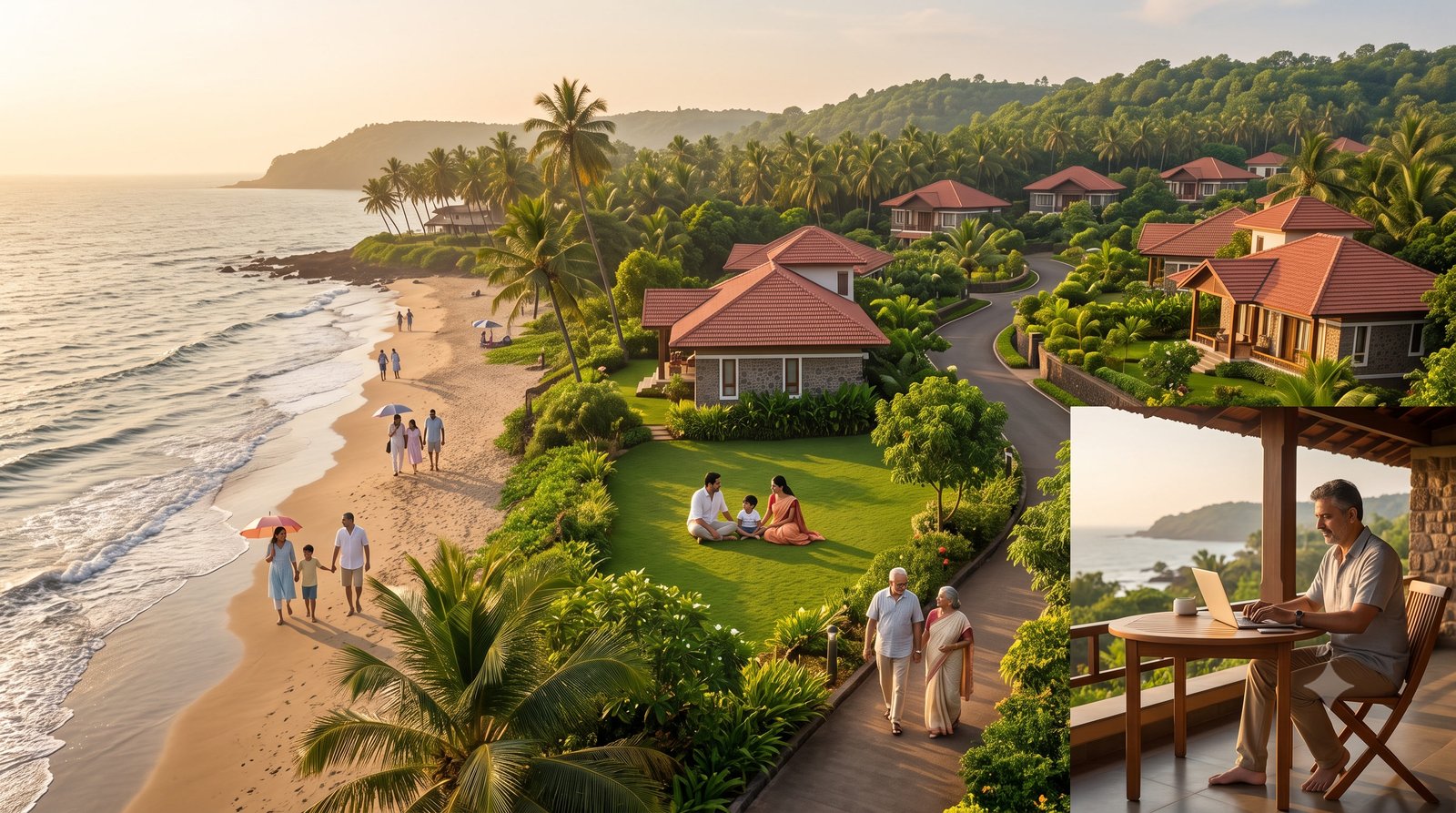
Understanding Your Property Choices
By the time buyers begin seriously exploring Ratnagiri, one question naturally follows.
"What should I buy?"
Should it be agricultural land?
An NA plot?
An existing bungalow?
A farmhouse?
A ready home?
There is no universal answer because every buyer has different objectives.
Someone planning retirement may prefer a ready-to-move-in house.
A younger family may prefer purchasing land first and constructing a home gradually.
Some buyers simply wish to own a small piece of Konkan for future generations.
Others may be looking for a weekend retreat that can be enjoyed immediately.
Whatever your objective, the first step should always be understanding the legal status of the property before becoming emotionally attached to it.
Agricultural Land, NA Plots And Ready Homes – Understand The Difference
One mistake first-time buyers often make is assuming that all land is similar.
It isn't.
Agricultural land has different regulations compared to Non-Agricultural (NA) land.
Similarly, a ready bungalow, an independent house and a plotted development each come with their own advantages and responsibilities.
Agricultural land often appeals to buyers who appreciate nature, orchards and open surroundings.
However, every agricultural property should be evaluated carefully from both a legal and practical perspective.
NA plots may suit buyers intending to construct residential properties, but buyers should independently verify all approvals and documentation instead of relying solely on verbal assurances.
Ready homes offer immediate usability, although maintenance, age of construction and documentation deserve equal attention.
The right choice is rarely about what is fashionable.
It is about what best matches your family's objectives.
Coastal Living Is Beautiful, But It Also Comes With Responsibilities
Many people dream about owning a home close to the sea.
Fresh air.
Open skies.
Beautiful sunsets.
A slower pace of life.
There is certainly something special about coastal living.
However, buyers should also understand the practical side.
Salt-laden air can gradually affect buildings.
Regular maintenance becomes more important than it might be in inland cities.
Heavy rainfall during the Konkan monsoon requires good drainage and thoughtful construction.
Homes that remain closed for several months should ideally be inspected periodically.
None of these points should discourage buyers.
They simply remind us that every lifestyle comes with responsibilities.
Understanding those responsibilities before purchasing usually leads to a much more satisfying ownership experience.
Buying Property For Investment? Think Long Term.
One question that almost every buyer eventually asks is,
"Do you think property prices will appreciate?"
Personally, I believe this question should be approached differently.
Instead of asking,
"How much will prices increase?"
a better question might be,
"Why do I want to buy this property in the first place?"
If your only objective is short-term appreciation, you may find yourself disappointed because no one can responsibly predict future property prices.
Markets move in cycles.
Government policies change.
Infrastructure projects progress at different speeds.
Economic conditions evolve.
However, buyers who focus on long-term ownership often evaluate properties differently.
They consider usability.
Lifestyle.
Family requirements.
Legal clarity.
Location quality.
Future generations.
If appreciation happens over time, it becomes an added advantage rather than the sole reason for purchasing.
In my opinion, that approach usually leads to better decision-making.
Retirement Living – Could Ratnagiri Be The Right Choice?
For many people, retirement is no longer simply about stopping work.
It is about choosing how they want to live.
Some dream of spending mornings surrounded by greenery.
Others imagine evening walks near the coastline.
Some want a quieter community where neighbours know each other.
Others prefer remaining close to large metropolitan cities.
Ratnagiri may suit buyers who value peace, nature and a slower lifestyle.
At the same time, retirement planning should always include practical considerations.
Healthcare.
Emergency services.
Banking.
Shopping.
Family accessibility.
Daily conveniences.
Before purchasing a retirement home, spend meaningful time in the area.
Experience everyday life rather than only holiday periods.
Retirement should never be based on imagination alone.
It should be based on comfort and confidence.
Before Buying, Ask Yourself These Questions
Rather than asking only,
"Is this property good?"
consider asking:
- Does this location genuinely suit my family's lifestyle?
- Will we actually use this property regularly?
- Is the documentation independently verified?
- Have I understood the applicable zoning regulations?
- Does the property have proper legal access?
- Have I visited during different seasons?
- Have I spoken with local residents?
- Am I buying because I genuinely like the location, or because someone promised appreciation?
These questions often reveal far more than glossy brochures ever can.
Common Mistakes Buyers Should Avoid
Every property market has its own challenges.
Ratnagiri is no exception.
Among the most common mistakes are:
- Purchasing after only one visit.
- Believing verbal promises without documentation.
- Ignoring legal verification.
- Assuming infrastructure guarantees appreciation.
- Focusing only on price while ignoring location quality.
- Not understanding CRZ or land classification where applicable.
- Purchasing emotionally instead of logically.
Most of these mistakes can be avoided simply by slowing down and verifying every important detail.
A Practical Buyer Checklist
Before making any property decision in Ratnagiri, consider the following checklist:
- Verify ownership and title history.
- Check 7/12 extracts and revenue records where applicable.
- Confirm land classification.
- Verify NA status if purchasing residential land.
- Understand applicable CRZ regulations.
- Confirm legal road access.
- Check electricity and water availability.
- Visit during different seasons.
- Speak with neighbouring property owners.
- Understand maintenance requirements.
- Verify surrounding development.
- Check proximity to healthcare facilities.
- Evaluate schools if purchasing for family use.
- Test mobile and internet connectivity.
- Understand local market access.
- Verify tax records.
- Consult a qualified legal professional.
- Never rely solely on verbal assurances.
- Purchase only after understanding the complete picture.
Final Thoughts
Ratnagiri has never needed publicity to establish its identity.
For generations it has been known for its coastline, culture, hospitality and world-famous Alphonso mangoes.
What appears to be changing today is not Ratnagiri itself.
It is the way buyers are beginning to look at it.
For some, it may become an excellent second-home destination.
For others, it could be a peaceful retirement option.
Some may simply enjoy spending weekends surrounded by nature.
Others may decide that another destination suits their lifestyle better.
Every one of those decisions is perfectly valid.
The objective of this article has never been to convince you that Ratnagiri is the perfect destination.
No such place exists.
Instead, the objective has been to encourage informed decision-making.
Visit the location.
Understand the people.
Verify the documentation.
Study the surroundings.
Take your time.
Buying property is not simply about purchasing land.
It is about choosing where a part of your life's journey may unfold.
Choose wisely.
About Dream Homes By Rahul Gargatte
At Dream Homes By Rahul Gargatte, our philosophy has always remained simple.
We believe buyers deserve knowledge before they make one of life's biggest financial commitments.
Whether you are exploring second homes, agricultural land, NA plots, retirement properties or long-term lifestyle opportunities across Maharashtra and Goa, our role is to help you understand the location before making a decision.
Every property has a story.
Every location has opportunities.
Every investment has responsibilities.
The more informed your decision, the better your chances of making the right one for yourself and your family.
References
This article has been prepared using publicly available information from authoritative sources, including the Ratnagiri District Administration, Maharashtra Tourism, Konkan Railway, National Highways Authority of India (NH-66), Government of Maharashtra public information portals, Census of India, and reporting from established publications such as The Times of India, The Hindu, The Indian Express, The Economic Times and Business Standard. Readers should always verify the latest government notifications, infrastructure updates and legal requirements before making any property-related decisions.
Frequently Asked Questions (FAQs)
1. Is Ratnagiri a good place to buy a second home?
For many buyers, the answer could be yes—but it depends on what you are looking for. If your objective is to own a peaceful coastal property surrounded by nature, Ratnagiri deserves consideration. If you are looking for an urban lifestyle with malls, nightlife and fast-paced city living, you may find other destinations more suitable.
2. Is Ratnagiri better than Goa?
Rather than asking which destination is better, I believe buyers should ask which destination better matches their lifestyle.
Goa offers a well-established tourism ecosystem, vibrant hospitality and international recognition.
Ratnagiri offers something different.
It offers Konkan culture, quieter surroundings, less commercialisation in many areas and a lifestyle that appeals to buyers seeking peace rather than crowds.
Neither destination is universally better.
The right choice depends entirely on your family's priorities.
3. Can Ratnagiri be considered for long-term property investment?
Every property purchase should first satisfy your personal objectives.
Infrastructure improvements, better connectivity and growing interest in coastal living may influence buyer demand over time.
However, nobody can responsibly guarantee future appreciation.
A property should be purchased because it suits your long-term goals—not solely because of expectations of higher prices.
4. Is Ratnagiri suitable for retirement?
Many retirees may appreciate Ratnagiri's slower pace of life, natural surroundings and Konkan culture.
However, retirement planning should also consider healthcare access, emergency services, banking, shopping and family convenience.
I would always recommend spending extended time in the area before making a retirement-related purchase.
5. Is agricultural land a better option than an NA plot?
Neither option is universally better.
Agricultural land and NA land serve different purposes and are governed by different regulations.
Every buyer should understand the legal implications, intended usage and documentation before making any decision.
6. How important is legal due diligence?
In my opinion, legal due diligence is one of the most important parts of any property purchase.
A beautiful property can quickly become a stressful investment if documentation is incomplete or unclear.
Never compromise on legal verification.
7. Should I rely on property advertisements alone?
No.
Advertisements are designed to introduce opportunities.
They should never replace your own verification.
Visit the property.
Meet local residents.
Understand the surroundings.
Verify every important document independently.
Only then should you make a decision.
8. How many times should I visit before purchasing?
Personally, I would recommend more than one visit.
If possible, visit during different seasons.
The experience of Ratnagiri during summer, monsoon and winter can be quite different.
The better you understand the location, the more confident your decision is likely to be.
A Final Word
Every district has its own identity.
Ratnagiri is no exception.
It has never tried to compete with Mumbai.
It has never tried to become another Goa.
Its strength lies in remaining true to its own character.
People visit Ratnagiri for many reasons.
Some come for the beaches.
Some for the temples.
Some for the world-famous Alphonso mangoes.
Some simply to reconnect with the Konkan they grew up visiting during school holidays.
Today, another group of people is beginning to discover Ratnagiri.
Property buyers.
Not because they believe every property here will become valuable overnight.
But because they are searching for something many modern cities struggle to offer.
Time.
Space.
Nature.
Peace.
Community.
Whether Ratnagiri eventually becomes your second home, your retirement destination or simply a place you continue visiting every year is a personal decision.
There is no perfect destination.
There is only the destination that best matches your family's dreams, lifestyle and long-term goals.
My advice remains exactly the same regardless of where you decide to buy.
Never rush.
Never depend only on marketing brochures.
Never purchase property because someone promises extraordinary returns.
Visit repeatedly.
Ask questions.
Verify documents.
Understand the location.
Take professional advice wherever necessary.
Most importantly, buy a property because it genuinely feels right for you and your family—not because everyone else is buying there.
Good property decisions are rarely made in a hurry.
They are built on patience, careful observation and informed judgement.
If this article helps you ask better questions before making your next property decision, then it has served its purpose.
About Dream Homes By Rahul Gargatte
Dream Homes By Rahul Gargatte is committed to helping buyers make informed property decisions across Maharashtra and Goa. Rather than focusing only on selling properties, our approach is centred on education, due diligence and long-term relationships.
Whether you are exploring NA plots, agricultural land, second homes, retirement properties or lifestyle investments, our objective is to help you understand the complete picture before making one of life's most important financial decisions.
Because buying the right property is not just about location.
It is about making the right decision.
Written By
Rahul Gargatte
Founder
Dream Homes By Rahul Gargatte
"Helping buyers make informed property decisions through knowledge, transparency and due diligence."
References
This article has been prepared using publicly available information from authoritative sources, including:
- Ratnagiri District Administration
- Government of Maharashtra
- Maharashtra Tourism
- Konkan Railway
- National Highways Authority of India (NH-66)
- Census of India
- Public reports from The Times of India, The Hindu, The Indian Express, The Economic Times and Business Standard, where relevant.
This blog is intended to encourage informed decision-making and should not be interpreted as investment advice or a guarantee of future property performance.