

Karjat, Maharashtra – A Comprehensive Guide to NA Plots, Villas, Farmhouses, Agricultural Land, Second Homes, Long-Term Property Ownership and Real Estate Due Diligence
Purchasing property is one of the most significant financial decisions an individual or family makes. Whether you are buying a weekend home, investing in land, planning your retirement, or evaluating a large development parcel, the quality of your decision depends far more on research and due diligence than on attractive marketing or social media trends.
This guide has been prepared as an educational resource to help genuine buyers, NRIs, families, investors, business owners and developers better understand Karjat from a practical property-buying perspective.
Every effort has been made to present information based on authentic and verifiable sources available at the time of publication. However, government regulations, planning policies, infrastructure projects, land records, taxation, environmental regulations and legal requirements can change over time. Every property is also unique. Two neighbouring parcels of land may have entirely different ownership histories, approvals, access rights, development potential or legal status.
Readers are therefore strongly encouraged to independently verify all property-specific information through the relevant government authorities and official records before making any financial commitment.
At Dream Homes By Rahul Gargatte, we believe that an informed buyer is a confident buyer. Our role goes beyond introducing property opportunities. We assist families, NRIs, investors and developers in understanding locations, evaluating projects, coordinating due diligence with our experienced in-house legal professionals and property experts, and helping clients make well-informed decisions before investing.
Buying Property in Karjat Is About More Than Finding a Beautiful Location

Ask ten people in Mumbai, Navi Mumbai, Thane or Pune what comes to mind when they hear the name Karjat, and the answers are likely to be very different.
Some immediately think about green mountains during the monsoon.
Some imagine peaceful farmhouses surrounded by nature.
Others picture weekend homes, rivers, waterfalls and relaxed countryside living.
Many investors see long-term possibilities, while developers evaluate land with an entirely different perspective.
Interestingly, none of these answers are completely wrong.
But none of them tell the complete story either.
One of the biggest mistakes buyers make is assuming that an entire region can be understood through a few photographs, social media videos or a single weekend visit.
Real estate simply doesn't work that way.
Beautiful scenery may encourage someone to visit a location, but it should never be the only reason to purchase property there.
Likewise, hearing about new infrastructure or increasing interest in an area should not automatically convince someone to invest without first understanding the property's legal status, surrounding development, accessibility and long-term suitability.
Karjat is a perfect example.
Unlike a township or a single residential project, Karjat is a diverse region with numerous villages, different landscapes, varying development patterns and multiple property categories. The experience of owning property can differ significantly depending on the exact location, topography, access road, surrounding infrastructure and applicable regulations.
Two buyers can purchase property in Karjat for completely different reasons.
A young family may want a peaceful second home where children can spend weekends close to nature. Families weighing hill-station alternatives often compare Karjat with Igatpuri as a long-term option and land near Lonavala and Malavli.
An NRI may be looking for a long-term investment while planning an eventual return to India. NRIs may also find our perspective on whether NRI property investments in India are safe useful.
A business owner may want a private retreat away from city life.
A developer may be evaluating larger land parcels for future projects.
Each of these buyers has different priorities.
Each requires different due diligence.
Each should ask different questions before investing.
That is exactly why this guide has been created.
Rather than trying to convince you that Karjat is the right choice for everyone, our objective is to help you understand where opportunities may exist, what practical realities should be considered, which documents deserve careful attention and how informed buyers generally approach one of the biggest financial decisions of their lives.
Over the years, we have interacted with numerous families, investors, NRIs and developers exploring property opportunities across Maharashtra. One common pattern consistently emerges.
People rarely regret spending extra time researching a property.
They are far more likely to regret making assumptions.
A little patience before purchasing often prevents significant problems later.
That philosophy continues to guide the work we do at Dream Homes By Rahul Gargatte. We believe transparency, proper due diligence and practical understanding create stronger property decisions than excitement alone.
Understanding Karjat Begins With Understanding Its Geography
One question I often ask buyers is surprisingly simple.
"Which part of Karjat are you referring to?"
The answer usually begins with silence.
Many people naturally assume that Karjat represents one uniform destination.
In reality, it does not.
Karjat is a taluka in Raigad district, Maharashtra, comprising numerous villages, established settlements, agricultural landscapes, river valleys, foothill regions and developing residential pockets. Looking at Karjat as one single property market can therefore be misleading. For a wider view of how the region is evolving, see our note on understanding Karjat’s growth beyond the real estate hype.
Understanding the exact location is often just as important as understanding the property itself.
A parcel of land located close to an established village may present a very different ownership experience compared with another parcel situated in a more remote agricultural belt.
Likewise, a residential layout near existing infrastructure may differ significantly from an isolated hillside property even if both share the same postal address.
This is why experienced buyers rarely stop their research after hearing the words "Karjat property."
Instead, they ask another question.
"Where exactly in Karjat?"
That single question often leads to a much clearer understanding of the property's surroundings, accessibility and practical suitability.
Karjat Is Not One Landscape — It Is Many Different Landscapes
One of the characteristics that makes Karjat attractive is also what makes property evaluation more important.
The region contains remarkable geographical diversity.
Within a relatively short drive, the landscape can change from established residential neighbourhoods to agricultural fields, village settlements, riverside environments, gently sloping terrain and foothill landscapes leading towards the Sahyadri ranges.
This diversity creates opportunities.
It also creates responsibility.
Every landscape should be evaluated differently.
Established Residential Localities
Some parts of Karjat have developed into established residential neighbourhoods supported by local markets, educational institutions, healthcare facilities, banking services and day-to-day conveniences.
These areas often appeal to families planning regular occupation or retirement rather than occasional weekend use.
However, even in established neighbourhoods, buyers should verify:
- Ownership history
- Approved building permissions
- Applicable planning regulations
- Water and electricity availability
- Road connectivity
- Property tax records
- Encumbrances, if any
Urban appearance should never replace proper verification.
Village Settlements
Many villages across Karjat continue to preserve their traditional identity while gradually adapting to changing residential preferences.
These areas often attract buyers seeking quieter surroundings and a stronger connection with local community life.
Village environments can offer an appealing lifestyle, but practical considerations remain equally important.
Before purchasing property, buyers should understand:
- Everyday accessibility
- Public transport availability
- Medical facilities nearby
- Educational institutions
- Internet and mobile connectivity
- Seasonal road conditions
Living peacefully also requires living practically.
Agricultural Landscapes
Agriculture continues to shape large parts of Karjat's character. Our guide on buying land in Maharashtra explains why agricultural parcels demand extra caution.
For this reason, agricultural land attracts attention from families seeking open spaces, investors exploring long-term ownership and developers studying future possibilities.
At the same time, agricultural land is frequently misunderstood.
Not every agricultural parcel is suitable for every purpose.
Land use, applicable laws, ownership records, access rights and statutory permissions should always be verified independently before proceeding with any transaction. Understanding RERA and zoning in Maharashtra is an essential part of this verification.
Buying agricultural land without fully understanding its legal and practical implications can lead to avoidable complications later.
River and Water Influenced Areas
Karjat's natural environment includes rivers, streams and seasonal watercourses that contribute significantly to its scenic appeal.
Properties near such areas may offer attractive surroundings, particularly during and after the monsoon.
However, responsible buyers should also understand practical aspects such as drainage patterns, seasonal water movement, accessibility during heavy rainfall and any applicable environmental considerations.
Scenic beauty should always be balanced with informed evaluation.
Foothill and Elevated Terrain
Several parts of Karjat transition gradually towards elevated landscapes and foothill environments.
These locations often attract buyers looking for privacy, natural surroundings and panoramic views.
Yet elevated terrain may involve additional considerations including construction feasibility, soil conditions, slope management, access roads and future maintenance requirements.
A spectacular view is undoubtedly valuable.
But long-term ownership requires much more than a beautiful view.
One Name, Hundreds of Different Buying Decisions
Perhaps the most important lesson for any buyer is this:
Buying property in Karjat is not about buying "Karjat."
It is about buying one specific property located in one specific village, having one specific survey number, one ownership history, one legal status and one set of approvals.
That distinction is extremely important.
Two plots situated only a few kilometres apart may differ substantially in documentation, development potential, accessibility and suitability.
This is precisely why Dream Homes By Rahul Gargatte encourages every buyer to look beyond brochures, advertisements and location names. We help clients evaluate not only the property's surroundings but also its documentation, practical realities and long-term suitability. Working alongside our experienced in-house legal professionals and property experts, we assist buyers in asking the right questions before making one of life's most significant financial decisions.
Sometimes, the difference between a confident purchase and an expensive mistake is not the property itself.
It is simply the quality of the research completed before the purchase.
Why Accessibility Often Shapes Long-Term Property Decisions in Karjat

Ask any experienced property buyer what influences the long-term usability of a property, and the answer is rarely limited to the property itself.
Connectivity plays an equally important role.
A beautiful farmhouse surrounded by greenery may appear ideal during a weekend visit, but if reaching it becomes inconvenient every time you travel, the excitement can gradually give way to frustration. Likewise, a residential plot located within a well-connected corridor may remain practical for decades because daily travel, emergency services, schools, hospitals and business centres remain reasonably accessible.
One of Karjat's greatest strengths is that it offers a countryside environment while remaining connected to some of Maharashtra's largest urban centres. That balance has contributed to growing interest from families, second-home buyers, NRIs, professionals, retirees and developers alike.
However, accessibility should never be judged simply by looking at a map.
Understanding how people actually travel to and from Karjat provides a much clearer picture.
Karjat's Strategic Position Within the Mumbai Metropolitan Region
Karjat is situated in Raigad district, Maharashtra, and forms part of the wider Mumbai Metropolitan Region (MMR). While it offers a noticeably different lifestyle from Mumbai or Navi Mumbai, it remains connected to these urban centres through an established transport network. If you are comparing coastal alternatives, see our Alibaug investment perspective.
For many buyers, this balance is one of Karjat's defining characteristics.
People can spend time surrounded by hills, rivers and open landscapes without feeling completely disconnected from business, education, healthcare or family commitments in larger cities.
That does not mean every part of Karjat enjoys identical accessibility.
Travel times vary depending on the exact village, road connectivity and final approach to the property.
This reinforces why buyers should evaluate the specific property's location rather than relying solely on the broader "Karjat" label.
Railway Connectivity Continues to Be One of Karjat's Biggest Strengths
Karjat Railway Station is an important station on Central Railway's Mumbai–Pune route, connecting the region with Mumbai, Thane, Kalyan, Dombivli, Badlapur, Ambernath, Pune and several other destinations through suburban and long-distance rail services.
For decades, the railway has shaped how people travel to and from Karjat.
Daily commuters use it for work.
Students use it for education.
Families use it for weekend travel.
Visitors use it to explore the surrounding region.
This long-established railway connectivity provides an advantage that many emerging locations do not possess.
For buyers considering a second home or retirement property, railway access often offers an alternative to driving, particularly during weekends or holiday periods.
If easy railway access is important to you, consider checking:
- Distance between the property and the nearest railway station.
- Availability of local transport from the station.
- Travel time during weekdays as well as weekends.
- Practical accessibility during the monsoon.
Road Connectivity: More Than Just Travel Time
Most property advertisements mention travel time.
Very few discuss the quality of the journey itself.
Karjat can be accessed through multiple road corridors depending on where you are travelling from.
Buyers from Mumbai, Navi Mumbai and Thane generally approach via the Mumbai Metropolitan Region road network before connecting towards Karjat.
Buyers travelling from Pune have different approach options depending on their starting point.
The important point is not simply whether the location is reachable.
It is whether the final approach to the property remains comfortable throughout the year.
When evaluating any property, ask yourself:
- Is the final access road paved?
- Does it remain usable during heavy rainfall?
- Can emergency vehicles reach the property easily?
- Is there legal access recorded for the property?
- Are bridges, culverts or low-lying stretches affected during the monsoon?
A property may be located only a few kilometres from a highway yet still have practical accessibility challenges during certain seasons.
The Importance of the Final Approach Road
One lesson repeatedly emerges during land evaluation.
The last few hundred metres often matter more than the first hundred kilometres.
Many buyers carefully evaluate the highway journey but pay little attention to the final access road leading to the property.
That can become an expensive oversight.
Before purchasing, personally inspect:
- Width of the approach road.
- Surface condition.
- Year-round usability.
- Legal access rights.
- Existing utilities along the road.
- Future maintenance responsibility.
Never assume that because neighbouring properties exist, every access arrangement is legally documented.
Independent verification is always advisable.
Navi Mumbai International Airport and Regional Connectivity
The commencement of operations at Navi Mumbai International Airport has added another major aviation hub within the Mumbai Metropolitan Region.
For many buyers—particularly NRIs, business owners and professionals—this enhances regional accessibility by providing an additional gateway alongside Chhatrapati Shivaji Maharaj International Airport.
However, buyers should interpret this development realistically.
An airport does not automatically transform every property into an outstanding investment.
Infrastructure improves regional accessibility, but the value and suitability of an individual property continue to depend on several other factors, including:
- Exact location.
- Legal documentation.
- Accessibility.
- Planning regulations.
- Surrounding development.
- Intended use.
- Long-term maintenance.
Infrastructure creates opportunities.
Due diligence determines whether those opportunities are suitable for a particular buyer.
Infrastructure Projects Should Be Understood, Not Assumed
One of the fastest ways misinformation spreads within real estate is through incomplete discussions about infrastructure.
Buyers often hear statements such as:
"There's a huge project coming."
"The road will definitely pass here."
"This area will soon become the next big destination."
Responsible buyers should pause whenever they hear such statements.
Instead of accepting verbal claims, ask:
- Has the project been officially announced?
- Which government authority is implementing it?
- What is the current status—operational, under construction or officially approved?
- Does it directly affect this specific property or only the wider region?
- Can the claim be verified through official documentation?
At Dream Homes By Rahul Gargatte, we encourage clients to separate verified information from market speculation. Infrastructure can influence accessibility and future development patterns, but purchasing decisions should never be based solely on rumours or promotional narratives.
Connectivity Means Different Things to Different Buyers
A retired couple may value peaceful surroundings over daily commuting.
An NRI may prioritise proximity to the airport.
A family may focus on schools and hospitals.
A developer may evaluate future infrastructure corridors.
A business owner may need quick access to Mumbai several times a week.
There is no universal definition of the "perfect location."
The best property is the one that aligns with your own objectives.
That is why every advisory discussion at Dream Homes By Rahul Gargatte begins with understanding the client's requirements before recommending locations. A property that is ideal for one buyer may be entirely unsuitable for another, even within the same village. Our guide on how to choose a location in Maharashtra expands on this idea.
Buyer Checklist: What to Verify Before Choosing a Location
Before finalising any property in Karjat, consider asking the following questions:
- How long does the journey actually take during peak traffic and weekends?
- Have I visited the property during different seasons?
- Is the final approach road legally accessible and practically usable?
- How far are schools, hospitals, markets and emergency services?
- Is railway access important for my family?
- Does the property's location genuinely suit my long-term plans?
- Have I verified infrastructure claims through official sources rather than relying on verbal assurances?
The answers to these questions often reveal far more about a property's suitability than an attractive brochure or a professionally produced promotional video.
Beyond Scenic Views: Understanding Everyday Life in Karjat Before You Buy
It is easy to fall in love with Karjat during a weekend visit.
The weather feels pleasant, the mountains create an impressive backdrop, rivers flow through the valley, and life appears noticeably slower than Mumbai, Navi Mumbai, Thane or Pune.
However, purchasing property is very different from planning a weekend getaway.
One of the questions I often encourage buyers to ask themselves is:
"Can I genuinely imagine living here—not just for two days, but for several years?"
That single question changes the way people evaluate a location.
A family begins looking at schools instead of viewpoints.
Senior citizens think about hospitals instead of holiday resorts.
Professionals consider internet connectivity instead of just mountain views.
Parents start asking about grocery stores, pharmacies and emergency services.
Developers begin evaluating surrounding infrastructure rather than only the land parcel itself.
This shift in thinking often leads to better long-term decisions.
Karjat Offers More Than Weekend Living
Although Karjat is widely recognised for second homes and weekend retreats, the region also supports everyday living for thousands of residents.
Markets operate throughout the week.
Schools and colleges serve local communities.
Healthcare facilities continue to expand.
Banks, government offices, transport services and essential businesses provide the infrastructure required for daily life.
For buyers planning permanent relocation or retirement, this distinction is important.
A location that functions only during weekends may not meet everyday requirements.
Karjat, on the other hand, combines natural surroundings with established local communities that have lived and worked here for generations.
| Priority | Weekend / Second Home | Permanent / Retirement Home |
|---|---|---|
| Healthcare access | Helpful but occasional | Critical — verify ambulance and hospital reach |
| Schools & education | Rarely relevant | Important for families relocating |
| Maintenance | Needs remote management when away | Handled day to day by residents |
| Connectivity | Weekend travel comfort | Daily commute, internet, essentials |
Understanding this balance helps buyers evaluate whether the location truly aligns with their lifestyle goals.
Families Should Evaluate More Than the Property
Parents naturally spend considerable time comparing layouts, amenities and prices.
Those factors certainly matter.
Yet after the purchase is complete, daily life usually revolves around different questions.
How far is the nearest school?
Where is the closest hospital?
Are grocery stores easily accessible?
Is internet connectivity reliable enough for online learning or remote work?
Can elderly family members access healthcare comfortably?
How practical is travelling during the monsoon?
These everyday considerations often influence long-term satisfaction far more than decorative entrance gates or attractive landscaping.
A thoughtfully selected location usually continues to serve a family well long after the excitement of moving in has passed.
Education Matters When Planning Long-Term Ownership
Families planning permanent or semi-permanent residence should carefully evaluate educational facilities around their preferred location.
Karjat and its surrounding region are served by schools offering different educational boards, while colleges and higher education options are available within the wider region and nearby urban centres.
Rather than selecting property first and researching schools later, many experienced buyers reverse the process.
They shortlist educational requirements first.
The property search then becomes much easier.
Before finalising any purchase, consider visiting nearby educational institutions personally rather than relying solely on online information.
Healthcare Should Never Be an Afterthought
One of the most overlooked aspects of property buying is healthcare accessibility.
Healthy individuals often assume this will never become an issue.
However, emergencies rarely provide advance notice.
When evaluating any location, ask practical questions.
How quickly can an ambulance reach the property?
Where is the nearest hospital?
Are specialists available nearby?
What happens during heavy rainfall?
How long would it take to reach advanced medical facilities if required?
For retirees, families with young children and buyers planning year-round living, these questions deserve careful consideration before purchasing.
Daily Conveniences Shape Long-Term Comfort
The quality of everyday life is often determined by small conveniences rather than major attractions.
Being able to purchase groceries without travelling long distances.
Accessing banking services easily.
Finding reliable local service providers.
Obtaining construction materials when building a home.
Access to pharmacies.
Fuel stations.
Restaurants.
Public transport.
These practical considerations become part of daily life long after the purchase is complete.
That is why experienced buyers usually spend an entire day exploring the surrounding locality instead of visiting only the property site.
Work From Home Has Changed Buyer Priorities
Over the last several years, remote and hybrid working arrangements have influenced how many professionals evaluate property.
Instead of travelling to an office every day, some people now divide their time between city residences and countryside homes.
Karjat has naturally attracted attention from buyers exploring this lifestyle.
However, successful remote working depends upon practical infrastructure.
Before purchasing, buyers should independently evaluate:
- Internet service providers available.
- Mobile network quality.
- Reliable electricity supply.
- Power backup options.
- Workspace feasibility.
- Travel flexibility when office visits become necessary.
A peaceful environment becomes far more enjoyable when daily work responsibilities can also be managed comfortably.
Retirement Living Requires Different Priorities
For many couples approaching retirement, Karjat represents an opportunity to exchange traffic, congestion and urban pressure for a calmer environment.
This can be an attractive lifestyle transition.
However, retirement planning should extend beyond beautiful surroundings.
Consider:
- Healthcare.
- Accessibility.
- Maintenance requirements.
- Security.
- Community support.
- Household services.
- Transportation.
- Future mobility.
Buying a property that remains comfortable twenty years from now is often more important than buying one that looks impressive today.
Weekend Homes Should Remain Easy to Maintain
Weekend homes continue to be one of the strongest reasons people explore Karjat.
Yet many buyers underestimate ongoing ownership responsibilities.
Questions worth considering include:
Who maintains the property when you are away?
How frequently should landscaping be managed?
What happens during extended monsoon periods?
How will routine maintenance be handled?
Are trusted local service providers available?
Can someone monitor the property during long absences?
These practical aspects influence ownership experience far more than many first-time buyers expect.
Every Buyer Has a Different Definition of the Perfect Property
One interesting observation from working with buyers over the years is that no two families define the "ideal property" in exactly the same way.
One family prioritises children's education.
Another values complete privacy.
A retired couple may prefer an established residential locality.
An investor may focus on future development.
A developer may study surrounding infrastructure and land aggregation opportunities.
An NRI may prioritise airport accessibility and simplified property management.
All of these perspectives are valid.
The important point is recognising that your requirements may differ significantly from someone else's.
That is why following market trends without understanding your own objectives often leads to disappointment.
How Dream Homes By Rahul Gargatte Helps Buyers Evaluate Lifestyle Suitability
Finding an attractive property is only one part of the decision-making process.
Understanding whether it genuinely suits your family's lifestyle is equally important.
At Dream Homes By Rahul Gargatte, we spend considerable time understanding each client's objectives before recommending suitable opportunities.
Some buyers require peaceful retirement living.
Others are searching for development land.
Some want an investment they can hold for years.
Others need a weekend retreat within comfortable travelling distance from Mumbai or Pune.
Rather than adopting a one-size-fits-all approach, we help buyers evaluate locations based on their intended use, practical requirements and long-term goals.
Where appropriate, our experienced in-house legal professionals and property experts also assist in reviewing available documentation so buyers can proceed with greater confidence before making any financial commitment.
Buyer Reality Check
Before finalising any property in Karjat, ask yourself these questions honestly.
- Can I see myself living here throughout the year?
- Have I visited the location during different seasons?
- Does this property suit my lifestyle rather than someone else's?
- Have I evaluated schools, healthcare and daily conveniences?
- Have I considered maintenance responsibilities?
- Does the location remain practical for my family ten years from now?
- Have I verified all important aspects before making any payment?
Property ownership is a long-term relationship with a location.
Choosing that location thoughtfully often becomes just as important as choosing the property itself.
Choosing the Right Type of Property in Karjat: NA Plots, Agricultural Land, Villas, Farmhouses or Apartments?
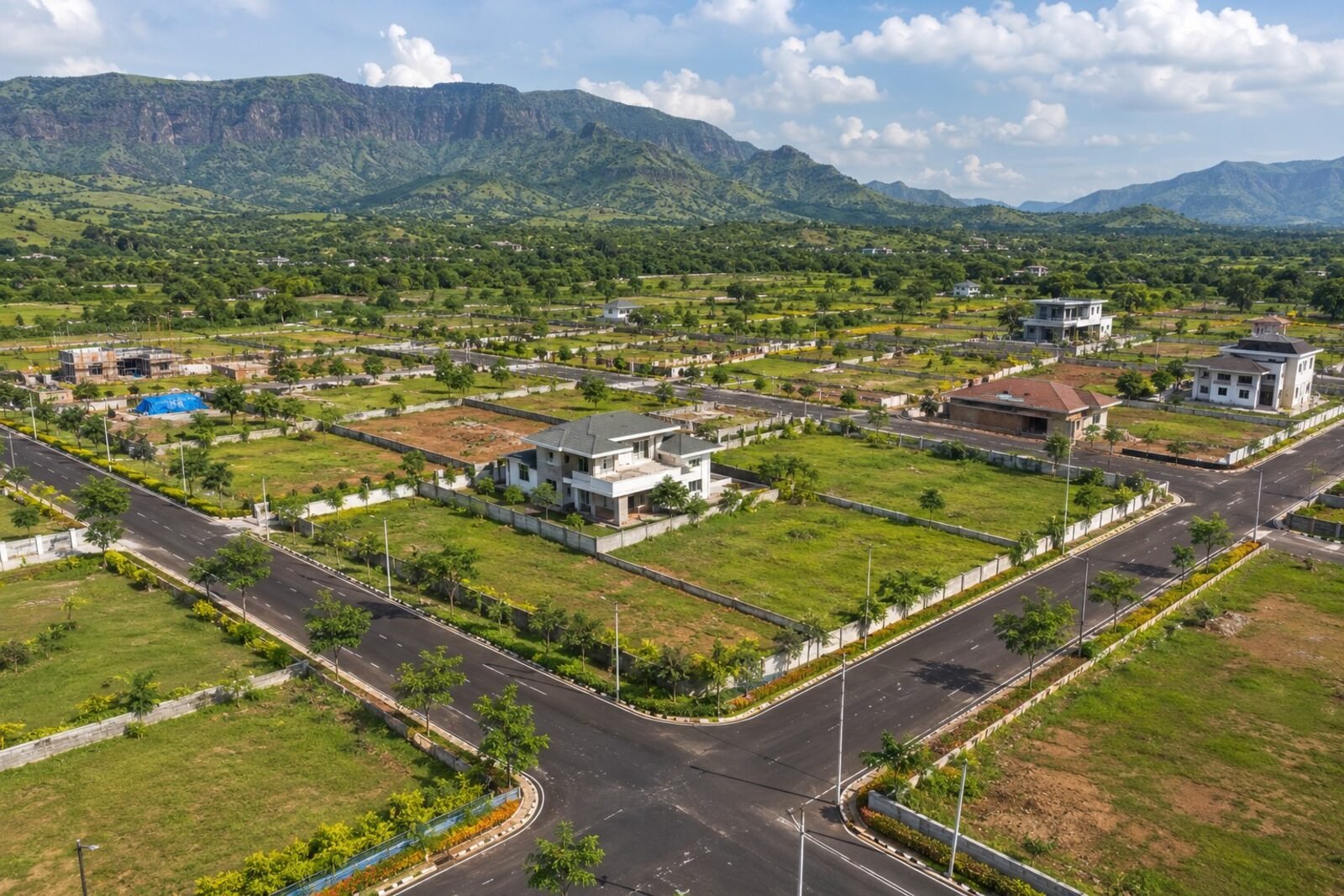
One of the biggest misconceptions among first-time buyers is that purchasing property begins with selecting a location.
In reality, experienced buyers usually begin somewhere else.
They first decide what kind of property best suits their objective.
This may sound like a small distinction, but it can significantly influence everything that follows—from legal documentation and financing to maintenance costs, future flexibility and long-term ownership experience.
Karjat offers a wide variety of property options. While this diversity creates opportunities, it can also confuse buyers who are unfamiliar with the practical differences between each property category.
A family looking for a retirement home has different priorities than an investor seeking capital appreciation.
An NRI may prefer a professionally managed villa, while a developer may be searching for larger land parcels with long-term development potential.
Understanding these differences before beginning your property search often saves considerable time, money and unnecessary complications.
Understanding NA Plots
Among the most popular choices in Karjat are Non-Agricultural (NA) Plots.
An NA plot is land that has received permission from the competent authority for non-agricultural use in accordance with applicable laws and regulations. However, buyers should always verify the exact nature and scope of the NA permission applicable to the specific property. Before committing, work through our detailed NA plot checklist for Maharashtra.
Many families prefer NA plots because they generally provide greater flexibility for future residential construction, subject to applicable planning regulations, local authority approvals and building permissions.
Some buyers purchase NA plots intending to construct their dream home immediately.
Others prefer holding the land for several years before beginning construction.
Some investors purchase NA plots as a long-term asset without immediate development plans.
Regardless of the purpose, buyers should independently verify:
- NA Order issued by the competent authority.
- Survey Number and Sub-Division details.
- Property Card or 7/12 Extract, as applicable.
- Mutation Entries.
- Access Road.
- Development permissions.
- Applicable planning authority.
- Utility availability.
- Encumbrance status.
Never rely solely on verbal statements that a plot is "NA."
Request documentary evidence.
| Consideration | NA (Non-Agricultural) Plot | Agricultural Land |
|---|---|---|
| Permitted use | Non-agricultural use as per the NA order, subject to planning rules | Primarily agricultural use unless converted |
| Construction flexibility | Generally greater, subject to local authority approvals | Restricted; depends on applicable laws |
| Key document | NA order + 7/12 / Property Card | 7/12 extract with land-use classification |
| Verification focus | Scope and validity of the NA permission | Land use, ownership records and access rights |
Is Every NA Plot the Same?
Absolutely not.
Two plots may both be described as NA, yet their practical usability may differ significantly.
For example:
One plot may have excellent road access, utility connections and surrounding development.
Another may technically be NA but still require considerable infrastructure before construction becomes practical.
Likewise, building regulations, setbacks, permissible construction and local planning requirements may vary depending on the property's location and governing authority.
This reinforces an important principle:
NA status is only one part of evaluating a property.
Understanding Agricultural Land
Agricultural land often attracts buyers because of its natural surroundings, larger parcel sizes and countryside appeal.
However, agricultural land is also one of the most misunderstood property categories in Maharashtra.
Many buyers incorrectly assume that purchasing agricultural land automatically allows construction of a farmhouse or residential structure.
The reality is often more nuanced.
The legal framework governing agricultural land depends upon multiple factors, including applicable laws, land classification, ownership records, intended use and permissions granted by the relevant authorities.
For this reason, buyers should avoid making assumptions based upon neighbouring properties or informal advice.
Instead, they should seek independent legal guidance and verify all relevant documentation before proceeding.
Important Questions Before Purchasing Agricultural Land
Responsible buyers should consider questions such as:
- What is the current classification of the land?
- What records are available?
- Does the property have legal access?
- Are there any restrictions affecting its intended use?
- Which authority governs the land?
- Are there environmental or planning considerations?
- Are there any existing encumbrances?
- What documentation is available regarding ownership history?
Obtaining clear answers before purchase is considerably easier than resolving disputes after ownership has transferred.
Villas: Suitable for Buyers Seeking Immediate Use
Some buyers prefer purchasing a completed villa rather than acquiring land and constructing a home themselves.
This option may be attractive for:
- Families seeking a ready second home.
- Retirees.
- NRIs visiting India periodically.
- Buyers who prefer predictable timelines.
Ready villas may reduce construction-related responsibilities.
However, buyers should still conduct comprehensive due diligence.
Do not assume that a completed structure automatically confirms legal compliance.
Independent verification remains equally important.
Before Purchasing a Villa
Verify:
- Ownership documents.
- Approved building plans.
- Occupancy-related approvals, where applicable.
- Utility connections.
- Property tax records.
- Society documentation, if applicable.
- Structural condition.
- Common area responsibilities.
- Maintenance obligations.
If purchasing within a gated community, carefully review the maintenance structure and recurring expenses before making a commitment.
Farmhouses: Lifestyle Meets Responsibility
Farmhouses have become increasingly popular among buyers seeking privacy and open spaces.
For many families, they represent an opportunity to spend weekends surrounded by nature while remaining within reasonable travelling distance of Mumbai or Pune.
Yet farmhouse ownership involves responsibilities beyond purchasing the land.
Owners should evaluate:
- Security arrangements.
- Property management.
- Landscaping maintenance.
- Water availability.
- Seasonal upkeep.
- Caretaking arrangements during extended absences.
A farmhouse that appears effortless during a weekend visit often requires regular maintenance throughout the year.
Apartments in Karjat
Apartments generally appeal to buyers seeking lower maintenance responsibilities compared with independent villas or farmhouses.
Depending upon the project, apartment living may offer shared amenities, security and community management.
However, buyers should still evaluate:
- MahaRERA registration (where applicable).
- Builder reputation.
- Maintenance charges.
- Parking.
- Construction quality.
- Society governance.
- Future maintenance obligations.
Buying an apartment should involve the same level of due diligence as purchasing any other property.
Which Property Type Suits Different Buyers?
There is no universally "best" property.
The right choice depends upon your objectives.
Families
Many families prioritise:
- Safety.
- Schools.
- Healthcare.
- Practical accessibility.
- Long-term residential comfort.
Depending on their plans, they may consider NA plots, ready villas or apartments.
Weekend Home Buyers
Weekend buyers often prioritise:
- Peaceful surroundings.
- Comfortable driving distance.
- Low maintenance.
- Scenic environment.
- Reliable access.
Ready villas and managed communities may suit some buyers, while others may prefer NA plots for future construction.
NRIs
Many NRIs value:
- Simplicity of ownership.
- Professional property management.
- Reliable documentation.
- Clear legal verification.
- Ease of future resale.
Because overseas buyers cannot frequently visit the property, documentation becomes even more important.
Long-Term Investors
Investors often evaluate:
- Location quality.
- Infrastructure.
- Legal clarity.
- Market demand.
- Long-term holding potential.
- Exit flexibility.
Investment decisions should be based upon careful analysis rather than expectations of guaranteed appreciation.
Builders and Developers
Developers generally evaluate factors extending well beyond the property itself.
These may include:
- Land aggregation possibilities.
- Planning regulations.
- Infrastructure.
- Accessibility.
- Environmental considerations.
- Development feasibility.
- Market demand.
Professional due diligence at this stage becomes particularly important.
Avoid Choosing Property Based Only on Price
One common mistake among first-time buyers is comparing properties only by price per square foot or price per acre.
In reality, two similarly priced properties may differ enormously in terms of:
- Documentation.
- Access.
- Development potential.
- Utility availability.
- Ownership history.
- Long-term practicality.
A lower purchase price does not necessarily represent better value.
Sometimes a property with stronger documentation and better accessibility proves to be the wiser long-term decision.
How Dream Homes By Rahul Gargatte Assists Different Types of Buyers
Every buyer's journey is different.
Some clients already know exactly what they want.
Others begin with only a general idea.
At Dream Homes By Rahul Gargatte, we first understand your objectives before recommending suitable property options.
Whether you are exploring NA plots, villas, agricultural land, apartments, farmhouses or larger development opportunities, our approach focuses on helping you evaluate the property's suitability rather than encouraging an immediate purchase.
Working alongside our experienced in-house legal professionals and property experts, we assist clients in coordinating document reviews, understanding available records, evaluating practical considerations and helping them make informed decisions with greater confidence.
Our objective is not simply to help you purchase property.
It is to help you purchase the right property.
Buyer Checklist Before Selecting Any Property Type
Before making your decision, ask yourself:
- What is my primary objective?
- How long do I intend to own the property?
- Will I use it regularly or occasionally?
- Am I prepared for construction if purchasing land?
- Have I understood the legal requirements?
- Does this property suit my family's long-term needs?
- Have I independently verified all important documentation?
- Am I choosing this property because it fits my goals—or simply because it looks attractive?
The answers to these questions often provide far greater clarity than any sales presentation ever could.
Speak With Our Advisory Team Before You Commit
Every parcel in Karjat has its own ownership history, approvals and access rights. Our in-house legal professionals and property experts help families, NRIs and investors verify documentation, coordinate due diligence and make informed, transparent decisions — long before any money changes hands.
Legal Due Diligence: The Most Important Step Before Buying Property in Karjat
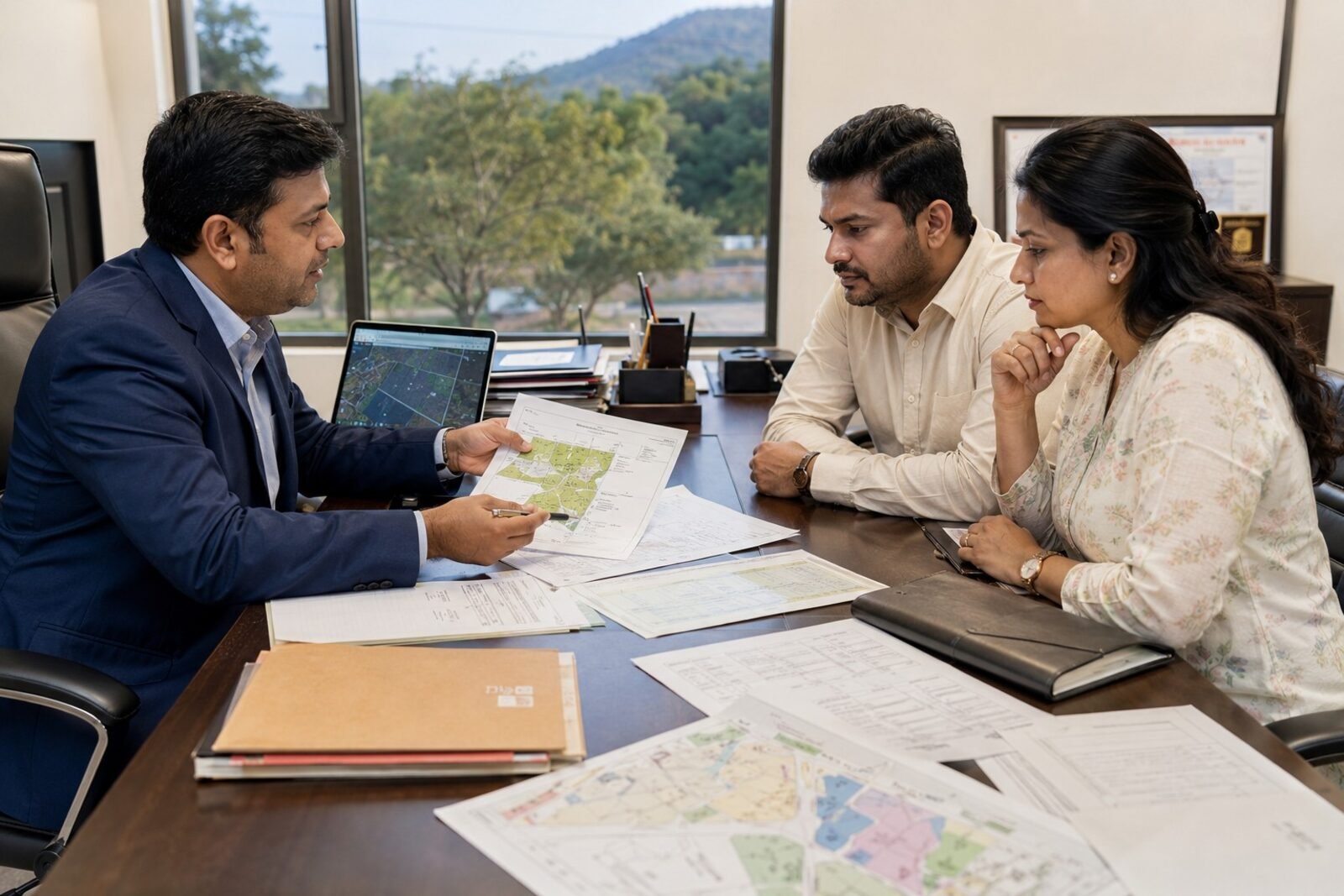
If there is one chapter in this guide that every buyer should read carefully, it is this one.
A property's beauty can be judged within minutes.
Its legal strength often takes days—or even weeks—to evaluate properly.
Many buyers spend hours comparing prices, layouts, amenities and views, but only a few devote the same level of attention to ownership records and legal documentation.
Ironically, it is the documentation—not the scenery—that determines whether a property can provide long-term peace of mind.
Across Maharashtra, many property-related disputes arise not because buyers intended to make poor decisions, but because important documents were never examined carefully before the transaction.
This chapter is not intended to create fear.
It is intended to help buyers understand why proper due diligence is one of the smartest investments they can make before signing any agreement.
What Does Legal Due Diligence Actually Mean?
Legal due diligence is the process of independently verifying that a property is legally suitable for purchase.
It involves examining ownership records, title history, applicable permissions, government records, planning regulations and any legal issues that may affect the property.
Simply receiving photocopies from a seller is not due diligence.
Similarly, relying on verbal assurances from brokers, neighbours or even developers should never replace independent verification.
A property transaction deserves documentary evidence.
Every Property Is Different
One of the most common misunderstandings among buyers is believing that documentation is identical for every property.
It is not.
A ready apartment, an NA plot, agricultural land, a farmhouse and a large development parcel may all require different sets of records and approvals.
Even neighbouring plots can have different ownership histories, survey records, access rights or legal issues.
This is why experienced buyers examine the specific property rather than making assumptions based on nearby land.
Begin With Ownership Verification
The first question every buyer should ask is simple:
Who legally owns the property?
The answer should never depend only on what the seller says.
Ownership should be supported by authentic documentary records available through the appropriate government authorities.
The objective is to establish that the person selling the property has the legal authority to transfer ownership.
If multiple owners exist, every owner's rights should be understood before proceeding.
Study the Chain of Title
Owning property today is only one part of the story.
Experienced buyers also examine how ownership reached the current seller.
This process is commonly referred to as examining the chain of title.
A clear ownership history helps establish continuity over time and reduces uncertainty.
Depending on the nature of the property, this may involve reviewing previous sale deeds, inheritance records, partition documents, gift deeds or other legally relevant documents.
The objective is not simply to collect paperwork.
It is to understand whether ownership has transferred lawfully over time.
Understand the Survey Number
Every property should be correctly identified.
The survey number (or other applicable land identification record) plays an important role in distinguishing one parcel from another.
Buyers should ensure that:
- The survey number matches the documents.
- The physical location corresponds with official records.
- Boundaries are correctly understood.
- Area measurements are consistent across documents.
Never assume that the land shown during a site visit automatically corresponds to the land described in the paperwork.
Review the 7/12 Extract Carefully
For many rural and semi-rural properties in Maharashtra, the 7/12 Extract (Satbara Utara) is an important revenue record.
While it provides valuable information, buyers should understand that it is not by itself proof of ownership.
Instead, it forms one part of the overall due diligence process.
Depending on the property, the record may contain information relating to:
- Survey details.
- Area.
- Occupancy information.
- Crop information where applicable.
- Mutation references.
Because revenue records change over time, buyers should always obtain the latest available records through official channels.
Don't Ignore Mutation Entries
Mutation entries record changes made in government revenue records following events such as sales, inheritance or other legally recognised transactions.
Reviewing these entries helps buyers understand whether ownership changes have been properly recorded.
Any inconsistencies should be clarified before proceeding.
Verify Whether the Property Is Free From Encumbrances
An attractive property can still carry legal or financial obligations.
Depending on the circumstances, buyers may need to verify whether any mortgages, court proceedings, financial claims or other encumbrances affect the property.
Independent legal review becomes especially valuable at this stage.
Proceeding without understanding existing obligations may create unnecessary complications later.
Check Access Rights Carefully
One of the most overlooked issues in land transactions involves road access.
Many buyers assume that because a vehicle reaches the property today, legal access automatically exists.
That assumption can be risky.
Ask questions such as:
- Is the access road legally recognised?
- Is it private or public?
- Who maintains it?
- Are access rights documented?
- Does every owner along the route recognise those rights?
Physical access and legal access are not always the same thing.
Verify the Applicable Planning Authority
Different properties may fall under different planning authorities or local governing bodies.
Understanding which authority has jurisdiction over the property helps buyers determine:
- Applicable planning regulations.
- Development permissions.
- Building requirements.
- Future approvals.
Assumptions should never replace official verification.
Understand Zoning and Land Use
Before purchasing any land, buyers should understand the property's existing land use classification and any applicable planning regulations.
Questions worth asking include:
- What is the present land use?
- Are there restrictions affecting future development?
- Does the intended use align with applicable regulations?
- Are additional permissions required?
These questions become particularly important for buyers intending to construct homes or undertake larger development projects.
Environmental Considerations Matter
Certain properties may be affected by environmental regulations depending on their location.
Responsible buyers should determine whether the property is affected by matters relating to:
- Forest regulations.
- River buffers.
- Flood-prone areas.
- Eco-sensitive considerations.
- Other statutory environmental requirements.
Environmental due diligence should always rely on official records rather than assumptions.
Never Skip a Physical Site Inspection
Documents tell one part of the story.
The property itself tells another.
Whenever possible, visit the property personally.
Observe:
- Actual boundaries.
- Road condition.
- Surrounding development.
- Nearby structures.
- Water flow during monsoon.
- Natural slope.
- Existing utilities.
- Neighbouring land use.
Sometimes a single site visit answers questions that paperwork alone cannot.
Questions Every Buyer Should Ask the Seller
Before making any commitment, consider asking:
- How long have you owned the property?
- Why are you selling?
- Are all original documents available?
- Are there any pending disputes?
- Has the property ever been mortgaged?
- Are all government dues paid?
- Have all applicable permissions been obtained?
Honest sellers generally welcome informed questions.
Why Independent Verification Is Always Better Than Assumptions
Modern technology has made property research easier than ever.
However, Google Maps, social media videos, promotional brochures and online discussions cannot replace official records.
Likewise, verbal assurances—regardless of who provides them—should always be supported by documentary evidence.
Independent verification protects both buyers and sellers by reducing misunderstandings before the transaction progresses.
How Dream Homes By Rahul Gargatte Supports the Due Diligence Process
At Dream Homes By Rahul Gargatte, we believe that buyers deserve clarity before commitment.
Rather than encouraging rushed decisions, we guide clients through a structured property evaluation process.
Depending on the nature of the transaction, we assist buyers by coordinating document reviews with our experienced in-house legal professionals and property experts, helping them understand available ownership records, title history, land classifications, access considerations, planning aspects and other important documentation relevant to the property.
Our objective is not to replace government authorities or legal advisors.
Instead, we help buyers organise, understand and evaluate available information so they can make informed decisions with greater confidence.
Buyer's Due Diligence Checklist
Before paying a booking amount, token or advance, ask yourself:
- Have I verified ownership?
- Have I reviewed the chain of title?
- Have I examined the latest revenue records?
- Have I checked mutation entries?
- Have I verified legal access?
- Have I understood land use and planning regulations?
- Have I confirmed whether any encumbrances exist?
- Have I personally inspected the property?
- Have I independently verified all important documents?
- Have I consulted experienced professionals before making my final decision?
Remember, a property purchase may last a lifetime.
Spending additional time on due diligence before signing the documents is almost always easier than resolving legal complications after the purchase is complete.
Understanding Government Authorities, Property Records & Approvals Before Buying in Karjat
Many first-time buyers believe that once they have found the right property, the remaining process is simply paperwork.
In reality, understanding which government authority maintains which record is one of the most important aspects of purchasing property.
A common mistake is assuming that a single document tells the entire story.
It does not.
Property ownership, land classification, planning permissions, registrations, taxation and development approvals are maintained by different government departments, each performing a specific function.
Understanding their responsibilities helps buyers ask better questions, obtain the correct documents and avoid unnecessary confusion.
This chapter is designed to provide a practical overview rather than legal advice. Every property is unique, and the applicable authorities and documentation may differ depending on the nature, location and intended use of the property.
Why Multiple Government Departments Are Involved
Unlike purchasing many consumer products, buying property involves multiple layers of administration.
For example:
- One department maintains land revenue records.
- Another registers sale deeds.
- A planning authority regulates development.
- A local authority may issue building-related permissions.
- Another department maintains cadastral surveys and maps.
Each authority performs a different function.
Understanding these responsibilities helps buyers appreciate why proper due diligence cannot rely upon a single document.
Revenue Department
The Revenue Department plays a significant role in maintaining land-related records across Maharashtra.
Depending on the property, buyers may encounter documents such as:
- 7/12 Extract (Satbara)
- Mutation Entries (Ferfar)
- Village Form records
- Revenue maps
- Survey references
These records assist buyers in understanding the property's revenue history and land details.
However, revenue records should always be considered alongside other relevant legal documents rather than in isolation.
Department of Registration & Stamps
Whenever a property transaction takes place through a registered sale deed, the Department of Registration and Stamps, Government of Maharashtra plays an important role.
Registration creates an official public record of the transaction.
Depending upon the transaction, registered documents may include:
- Sale Deeds
- Gift Deeds
- Release Deeds
- Partition Deeds
- Mortgage-related documents
- Other legally registrable instruments
Buyers should ensure that registered documents correspond correctly with the property's particulars and ownership history.
Survey and Land Records
Every property should be properly identified.
Survey records assist in determining:
- Survey Number
- Area
- Boundary identification
- Land measurements
- Sub-divisions where applicable
Whenever uncertainty exists regarding boundaries or measurements, buyers should seek clarification before completing the purchase.
Never assume that fences, compound walls or verbal descriptions accurately represent legal boundaries.
Planning Authorities
Development within any region is generally regulated by the applicable planning authority.
Depending upon the property's location, different authorities may exercise planning jurisdiction.
Planning authorities typically regulate matters relating to:
- Land use planning
- Development permissions
- Building regulations
- Layout approvals
- Infrastructure planning
Before purchasing land with construction intentions, buyers should understand which planning authority governs the property.
Local Self-Government Bodies
Depending on where the property is situated, local governance may be administered through:
- Municipal Councils
- Municipal Corporations
- Gram Panchayats
- Other statutory local authorities
These bodies may perform functions relating to civic administration, local infrastructure and certain permissions within their jurisdiction.
Understanding the local administrative structure often helps buyers better appreciate future maintenance and civic services available around the property.
MahaRERA
Where applicable, buyers considering real estate projects should verify whether the project falls under the provisions of the Maharashtra Real Estate Regulatory Authority (MahaRERA).
For applicable projects, buyers may independently verify information available through the official MahaRERA portal, including registration details and disclosures required under the law.
However, not every property transaction necessarily falls within MahaRERA's scope.
Individual land transactions, resale properties and other categories may involve different legal considerations.
Understanding these distinctions is important.
Forest and Environmental Authorities
Certain properties may require additional verification depending upon their location.
Buyers should exercise particular caution where land is situated near:
- Forest areas
- Reserved forests
- Protected environments
- Rivers
- Water bodies
- Eco-sensitive regions
Environmental regulations exist for important public purposes and should always be respected.
Independent verification through the relevant authorities is advisable whenever environmental considerations may affect the property.
Utility Service Providers
Many buyers assume utilities automatically become available after purchasing land.
That is not always the case.
Before purchasing, understand the practical availability of:
- Electricity
- Water supply
- Drainage arrangements
- Internet connectivity
- Mobile network coverage
Availability may differ considerably depending upon the property's exact location.
Property Tax and Local Records
Depending upon the property's nature and location, buyers should also understand:
- Applicable property taxes.
- Outstanding dues, if any.
- Local assessments.
- Maintenance obligations.
Request documentary evidence wherever applicable.
Financial liabilities attached to property should never come as a surprise after purchase.
Documents Every Buyer Should Understand
Although documentation requirements differ from property to property, buyers commonly encounter documents such as:
- Registered Sale Deed
- Previous Title Documents
- 7/12 Extract (where applicable)
- Mutation Entries
- Property Card (where applicable)
- Survey Records
- Layout Plans
- NA Order (where applicable)
- Building Plan Approvals (where applicable)
- Occupancy-related approvals (where applicable)
- Tax Receipts
- Identity documents of the seller
- Encumbrance-related records, where necessary
The objective is not merely to collect documents.
It is to understand what each document confirms—and equally important, what it does not.
Beware of Common Documentation Myths
During property transactions, buyers often hear statements such as:
"Everything is clear."
"All documents are perfect."
"There is nothing to worry about."
While these statements may ultimately prove correct, responsible buyers should still request documentary evidence.
Documentation should answer questions—not replace them.
Similarly, possessing one document does not eliminate the need to examine others.
Due diligence is most effective when viewed as a complete process rather than a checklist completed with a single paper.
Digital Verification Has Become Easier—But It Still Requires Care
Many government departments now provide online access to selected records and public information.
This has undoubtedly improved transparency.
However, buyers should remember:
- Not every record is available online.
- Digital information should correspond with original documentation.
- Certified records may still be necessary in certain situations.
- Professional interpretation may sometimes be required.
Technology is an excellent research tool.
It should not replace proper verification.
How Dream Homes By Rahul Gargatte Helps Buyers Navigate Documentation
Many buyers tell us that the most confusing part of purchasing property is not selecting the property—it is understanding the documentation.
At Dream Homes By Rahul Gargatte, we help simplify this process.
Our role is to help buyers understand what documents are generally relevant, what questions deserve attention and which records should be independently verified before making financial commitments.
Working alongside our experienced in-house legal professionals and property experts, we assist clients in organising available documentation, identifying areas requiring further clarification and coordinating structured due diligence appropriate to the property's nature.
Every property deserves careful evaluation.
Every buyer deserves complete clarity before investing.
Buyer Checklist: Understanding Government Records
Before finalising any property, ask yourself:
- Do I know which government authority governs this property?
- Have I obtained the latest available records?
- Have I independently verified ownership?
- Have I understood the applicable planning authority?
- Have I confirmed whether environmental restrictions apply?
- Have I verified taxes and local dues?
- Have I checked all approvals relevant to this property's intended use?
- Have I reviewed the documents with experienced professionals before signing?
Buying property becomes significantly less stressful when buyers understand not only what documents they possess, but also why each document matters.
Buying Property in Karjat: A Practical Guide for NRIs, Investors, Builders and Developers
Every buyer enters the market with a different objective.
A retired couple looking for a peaceful home is unlikely to evaluate a property the same way as a real estate developer.
An NRI living overseas will have concerns that differ from those of a local buyer.
Similarly, a long-term investor searching for capital preservation may focus on entirely different factors than someone planning to build their dream home immediately.
One of the biggest mistakes buyers make is following advice meant for someone else.
A property that is perfect for a developer may not suit a family.
A beautiful farmhouse may not be the ideal investment for an NRI who visits India only once a year.
A residential plot may not satisfy the objectives of someone planning to generate rental income.
The first step should therefore be understanding your own purpose before evaluating any property.
Buying a Second Home
Karjat has long attracted families searching for a second home away from the pace of city life.
For many buyers, the objective is not investment alone.
They want a place where children can experience nature, parents can unwind over weekends and the family can spend quality time together.
When evaluating a second home, ask practical questions.
How frequently will you visit?
Will elderly family members also use the property?
How easy is the journey during weekends and monsoons?
Can the property remain secure while you are away?
How much maintenance will be required throughout the year?
The answers to these questions are often more important than the property's size.
Buying a Retirement Home
Retirement planning requires thinking many years ahead.
A peaceful environment is undoubtedly attractive.
However, comfort during retirement depends upon much more than beautiful surroundings.
Before selecting a retirement property, consider:
- Distance from hospitals.
- Access to pharmacies.
- Availability of domestic help.
- Grocery stores.
- Banking services.
- Internet connectivity.
- Emergency transportation.
- Road accessibility.
The ideal retirement property should continue supporting your lifestyle for decades rather than simply looking attractive during the first visit.
Buying Property as an NRI
Many Non-Resident Indians continue to maintain strong emotional and financial connections with India.
Some plan to return after retirement.
Others wish to diversify investments.
Many simply want a secure family asset.
While these objectives vary, NRIs often share similar practical concerns.
Questions frequently include:
Can I manage the property from overseas?
How do I verify documentation while living abroad?
Who will supervise the property?
How can I avoid fraudulent transactions?
Who will coordinate with government authorities if required?
How can I complete due diligence without making repeated visits to India?
These are entirely reasonable concerns.
For this reason, documentation, transparency and professional guidance become even more important for overseas buyers.
Property Management Is an Important Consideration for NRIs
Owning property from another country is very different from owning property in the same city where you live.
Maintenance should never be overlooked.
Consider:
- Routine inspections.
- Security.
- Landscape maintenance.
- Utility bill management.
- Repairs.
- Caretaking arrangements.
Many NRIs focus exclusively on purchasing the property but devote little attention to long-term management.
Planning ahead often prevents future inconvenience.
Long-Term Investors Should Think Beyond Market Sentiment
Every real estate cycle creates optimism.
Every cycle also creates unrealistic expectations.
Responsible investors understand that property markets move over long periods.
Rather than asking,
"How much will prices increase?"
Experienced investors often ask,
"Is this fundamentally a sound property?"
That subtle difference changes the entire investment approach.
Instead of relying on speculation, evaluate:
- Documentation.
- Accessibility.
- Practical usability.
- Surrounding development.
- Demand fundamentals.
- Long-term ownership costs.
- Exit flexibility.
No responsible advisor can guarantee future appreciation.
However, careful due diligence helps reduce avoidable risks.
Builders and Developers Evaluate Land Differently
Developers typically examine land from a broader planning perspective.
While families may focus on views and lifestyle, developers often analyse:
- Parcel size.
- Road frontage.
- Land aggregation possibilities.
- Applicable planning regulations.
- Existing infrastructure.
- Utility availability.
- Environmental considerations.
- Market demand.
- Future development feasibility.
Larger land transactions usually require considerably deeper technical, legal and commercial due diligence.
Every document deserves careful scrutiny before negotiations progress.
Commercial Buyers Should Evaluate Business Objectives
Some buyers purchase property not for residential use but for commercial purposes.
Depending upon applicable regulations and planning permissions, objectives may include:
- Hospitality.
- Wellness retreats.
- Educational institutions.
- Warehousing.
- Industrial support services.
- Tourism-related businesses.
- Agricultural enterprises.
Business objectives should always align with applicable regulations.
Never purchase property assuming approvals will automatically be available later.
Buying Property for Future Generations
Many families purchase land not because they intend to use it immediately, but because they wish to create a long-term family asset.
This approach requires patience.
Unlike short-term investments, land often remains within families for decades.
When purchasing for future generations, buyers should consider:
- Ease of succession.
- Proper documentation.
- Boundary clarity.
- Long-term maintenance.
- Security.
- Family ownership planning.
Clear records today can prevent family disputes many years later.
First-Time Buyers Should Avoid Emotional Decisions
Buying your first property is exciting.
It is also easy to become emotionally attached.
A beautiful entrance gate.
Mountain views.
Landscaped gardens.
Promotional offers.
Limited-period discounts.
These features can create urgency.
Responsible buyers slow down at exactly this stage.
Ask yourself:
Have I verified every important document?
Have I visited the property more than once?
Have I understood all long-term costs?
Have I independently verified ownership?
Am I buying because it genuinely suits my objectives—or because I fear missing an opportunity?
The right property will continue to make sense even after careful verification.
Questions Every Buyer Should Ask Before Making a Booking
Regardless of whether you are an NRI, investor, developer or family, ask these questions before paying any booking amount:
- Why am I buying this property?
- What is my expected holding period?
- Have I understood the property's legal position?
- Have I evaluated maintenance requirements?
- Does this property suit my long-term objectives?
- Have I independently verified all important documentation?
- Have I consulted experienced professionals before making my decision?
The clearer your answers, the stronger your purchasing decision is likely to become.
How Dream Homes By Rahul Gargatte Supports Different Types of Buyers
No two buyers have identical requirements.
At Dream Homes By Rahul Gargatte, our advisory process begins by understanding your objective—not by recommending a property immediately.
A family searching for a second home deserves different guidance from an NRI purchasing remotely.
A developer evaluating larger land parcels requires different documentation than someone buying a residential plot.
Our experienced in-house legal professionals and property experts help clients coordinate structured due diligence, review available documentation, understand practical considerations and evaluate whether a property aligns with their intended purpose.
Our philosophy is straightforward.
We believe buyers should invest with clarity rather than uncertainty.
That approach has helped us build lasting relationships with families, investors, NRIs and developers who value professional guidance before making significant property decisions.
Buyer Self-Assessment Checklist
Before beginning your property search in Karjat, complete this simple exercise.
- What is my primary objective?
- How long do I intend to hold the property?
- Will I use it personally or purely as an investment?
- What level of maintenance am I comfortable with?
- Am I prepared to complete thorough due diligence?
- Have I allocated a realistic budget for taxes, registration, maintenance and future expenses?
- Who will manage the property if I cannot?
- Have I chosen this property because it supports my goals—or because someone else recommended it?
The answers to these questions often provide greater clarity than months of browsing property advertisements.
Common Mistakes Buyers Make When Purchasing Property in Karjat – And How to Avoid Them
Every experienced property advisor has seen it happen.
A buyer finds an attractive property.
The location feels perfect.
The surroundings are beautiful.
The price appears reasonable.
The seller seems trustworthy.
Within a few days, the buyer pays a token amount.
Only afterwards do they begin asking important questions about ownership, approvals, access roads, land classification and legal documentation.
Unfortunately, the correct sequence should have been exactly the opposite.
Most property-related problems do not arise because buyers deliberately ignore risks. They occur because buyers become emotionally attached to a property before completing proper due diligence.
Karjat is no exception.
Whether you are purchasing an NA plot, agricultural land, villa, farmhouse or development parcel, avoiding a few common mistakes can save significant time, money and stress.
Mistake 1: Falling in Love With the Property Before Verifying the Documents
Beautiful landscapes have a powerful emotional effect.
A mountain view.
A flowing river.
Cool weather.
Open green spaces.
These are all genuine attractions.
However, they should never become substitutes for legal verification.
Some buyers become so excited during the first visit that they mentally decide to purchase the property before examining a single document.
Experienced buyers do the opposite.
They appreciate the location, but postpone emotional decisions until documentation has been independently verified.
A beautiful property with incomplete documentation rarely becomes a wise purchase.
Mistake 2: Believing Everything Heard During the Site Visit
Most sellers genuinely want to present their property in the best possible light.
That is understandable.
However, responsible buyers should distinguish between marketing statements and independently verifiable facts.
For example:
"This road will become a major highway."
"This area will definitely become the next big investment destination."
"Prices are guaranteed to double."
"Construction permission will never be a problem."
Statements like these should always lead to one simple question:
Can this information be verified through official records or competent authorities?
If the answer is unclear, further investigation is advisable.
Mistake 3: Assuming Every Property in Karjat Is Similar
One of the biggest misconceptions is treating Karjat as a single uniform market.
In reality, every village, locality and land parcel has its own characteristics.
Accessibility differs.
Planning regulations may differ.
Infrastructure differs.
Surrounding development differs.
Documentation differs.
Even neighbouring properties may have completely different ownership histories.
Never purchase one property simply because another nearby property appears attractive.
Evaluate each property independently.
Mistake 4: Paying a Token Amount Too Quickly
Many buyers worry that they might lose an opportunity if they do not make an immediate payment.
Occasionally, this urgency is genuine.
Sometimes it is simply sales pressure.
Before paying any booking amount or token, ask yourself:
Have I seen the important documents?
Have I understood the ownership history?
Have I independently verified the information?
Have I obtained professional advice where necessary?
A small delay for proper verification is often preferable to rushing into a decision that cannot easily be reversed.
Mistake 5: Ignoring the Access Road
Buyers frequently focus on the property itself while overlooking the route leading to it.
This can become a practical challenge later.
Questions worth considering include:
Is the road legally accessible?
Does it remain usable during heavy rainfall?
Can construction vehicles reach the site?
Can emergency services access the property?
Who maintains the road?
Is the road public or private?
Never assume that an existing road automatically guarantees legal access rights.
Mistake 6: Visiting Only Once
Properties often create a strong first impression.
However, one visit rarely tells the complete story.
Whenever possible, visit:
- On a weekday.
- During a weekend.
- During the monsoon, if practical.
- At different times of the day.
Observe:
Traffic.
Noise levels.
Water flow.
Neighbouring activity.
Road conditions.
Lighting.
General surroundings.
Multiple visits usually provide a much clearer understanding of the property's long-term suitability.
Mistake 7: Ignoring Future Maintenance
Owning property involves more than purchasing it.
Ask practical questions.
Who will maintain the property?
Who will care for landscaping?
How will repairs be handled?
What happens if you remain away for several months?
Is there reliable local support?
Maintenance planning should begin before purchase—not afterwards.
Mistake 8: Buying Without Understanding Long-Term Costs
Many first-time buyers calculate only the purchase price.
In reality, ownership may involve additional expenses such as:
- Stamp duty and registration charges.
- Legal and professional fees.
- Property taxes.
- Maintenance expenses.
- Security arrangements.
- Utility connections.
- Construction costs, where applicable.
- Landscaping and upkeep.
Understanding the complete financial picture allows buyers to budget more confidently.
Mistake 9: Overlooking the Surrounding Area
A property does not exist in isolation.
Its surroundings influence ownership experience every day.
During your visit, observe:
Nearby development.
Road quality.
Neighbouring land use.
Commercial activity.
Healthcare facilities.
Schools.
Markets.
Public transport.
Future infrastructure visible on the ground.
A wonderful plot surrounded by practical challenges may not remain enjoyable over the long term.
Mistake 10: Believing That Documentation Can Be Completed Later
One of the costliest assumptions is believing that documentation can always be "sorted out later."
Responsible buyers reverse this thinking.
Documentation should be understood before commitments are made.
Ownership should be verified before money changes hands.
Planning regulations should be understood before construction is planned.
Questions should be answered before agreements are signed.
This approach reduces uncertainty and protects all parties involved.
Mistake 11: Depending Entirely on Online Information
The internet has made property research much easier.
However, online information has limitations.
Videos may highlight only attractive areas.
Photographs capture a single moment.
Maps may not reveal legal boundaries.
Social media often rewards excitement rather than accuracy.
Online research is an excellent starting point.
It should never become the final stage of due diligence.
Mistake 12: Not Taking Professional Advice
Buying property is often one of the largest financial decisions people make.
Yet some buyers hesitate to seek professional guidance.
Independent advice from experienced legal professionals, surveyors, chartered accountants or property advisors often helps identify questions that first-time buyers may never think to ask.
Professional guidance does not guarantee a perfect transaction.
However, it frequently helps reduce avoidable mistakes.
A Simple Rule That Experienced Buyers Follow
There is one principle that experienced property buyers apply consistently:
The more attractive the property appears, the more carefully they verify the documentation.
They understand that confidence comes from evidence—not assumptions.
Every answer should be supported by records.
Every important statement should be capable of independent verification.
Every decision should be made with patience rather than pressure.
How Dream Homes By Rahul Gargatte Helps Buyers Avoid Costly Mistakes
At Dream Homes By Rahul Gargatte, we believe our responsibility begins long before a buyer signs an agreement.
Our role is not limited to introducing properties.
We help buyers ask the questions that experienced investors ask.
Working alongside our experienced in-house legal professionals and property experts, we assist clients in reviewing available documentation, understanding practical considerations, identifying areas requiring further verification and coordinating a structured due diligence process before financial commitments are made.
Whether you are purchasing your first property or adding to an existing portfolio, our objective remains the same—to help you make an informed decision based on clarity rather than assumptions.
Buyer Checklist: Have You Avoided These Common Mistakes?
Before finalising any property, ask yourself:
- Have I independently verified the documentation?
- Have I visited the property more than once?
- Have I understood the surrounding locality?
- Have I checked legal access?
- Have I evaluated long-term maintenance?
- Have I understood the total cost of ownership?
- Have I verified important claims through official sources?
- Have I sought professional guidance before making my decision?
Buying property is not a race.
The buyers who take the time to ask the right questions are often the ones who enjoy the greatest peace of mind long after the transaction is complete.
Infrastructure, Future Development & Regional Growth: Understanding What Really Matters Before Buying Property in Karjat
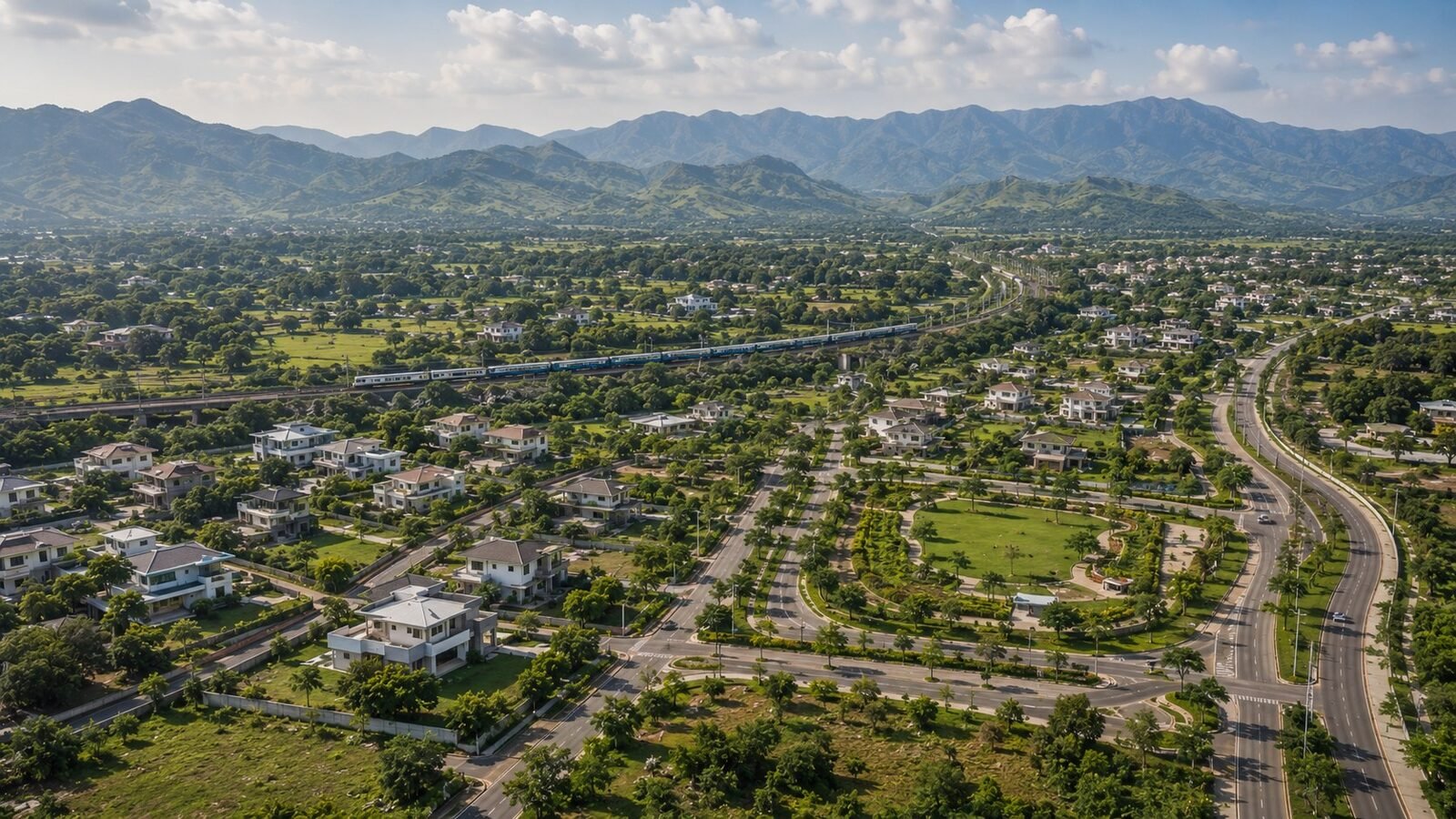
When buyers begin researching Karjat, one topic appears repeatedly—infrastructure.
Roads.
Railways.
Airports.
Bridges.
Industrial corridors.
Government announcements.
Every few months, new discussions emerge about projects that could influence the wider region.
Some of these developments are genuine and officially progressing.
Others are based on assumptions, rumours or incomplete information.
For a property buyer, understanding the difference is extremely important.
Infrastructure certainly has the potential to improve accessibility, encourage economic activity and influence long-term development patterns.
However, no infrastructure project—regardless of its scale—can automatically guarantee the future performance of an individual property.
Responsible buyers therefore focus on verified information rather than market speculation.
Infrastructure Should Improve Your Lifestyle—Not Drive Emotional Decisions
Many buyers hear statements such as:
"A new road is coming."
"This airport will transform everything."
"Prices will double after this project."
"You must buy now before it's too late."
While infrastructure improvements can positively influence a region over time, purchasing property solely because of a proposed project is rarely a sound strategy.
Instead, ask yourself:
- Does this project genuinely improve my accessibility?
- Is the project officially operational, under construction or only proposed?
- Does it directly affect the specific property I am considering?
- Even without this project, would I still be comfortable owning this property?
If the answer to the last question is "no," the purchase deserves additional thought.
The Importance of Regional Connectivity
Karjat's appeal is not based on one single infrastructure project.
Rather, it benefits from being connected to one of India's largest metropolitan regions while still offering a distinctly different lifestyle.
For buyers from Mumbai, Navi Mumbai, Thane and Pune, this balance often becomes an important consideration.
Being able to leave a busy city environment and reach a peaceful countryside setting within a reasonable journey is one of Karjat's long-standing strengths.
This advantage has existed for many years and continues to influence buyer interest.
Railway Connectivity Continues to Support the Region
Karjat has historically benefited from its position on the Central Railway network.
Rail connectivity supports:
- Daily commuters.
- Students.
- Local businesses.
- Weekend travellers.
- Visitors.
- Residents.
Unlike locations that depend entirely on road transport, railway access provides an additional transportation option that many families value.
For buyers planning frequent travel, proximity to a railway station may become a practical advantage.
Road Networks Continue to Improve Accessibility
Road infrastructure plays an equally important role.
Improved highways and regional road connectivity have made travelling between Karjat and nearby urban centres more convenient than in previous decades.
However, buyers should distinguish between regional roads and the final access road leading to the property itself.
A property may be close to an excellent highway while still having a narrow or poorly maintained internal approach road.
Always inspect both.
Navi Mumbai International Airport and Its Regional Significance
The operational commencement of Navi Mumbai International Airport represents one of the most significant infrastructure developments within the Mumbai Metropolitan Region in recent years.
For property buyers, particularly NRIs and business professionals, the airport improves regional connectivity by providing an additional international aviation gateway.
However, it is equally important to maintain realistic expectations.
The airport benefits the broader region by strengthening transportation infrastructure.
It does not automatically increase the value of every property across Karjat.
Individual properties continue to be influenced by factors such as:
- Documentation.
- Accessibility.
- Location.
- Demand.
- Planning regulations.
- Maintenance.
- Intended use.
Infrastructure contributes to opportunity.
Property quality determines long-term ownership value.
The Mumbai Trans Harbour Link (Atal Setu)
The Atal Bihari Vajpayee Sewri–Nhava Sheva Atal Setu has significantly improved connectivity between Mumbai and Navi Mumbai.
For many travellers approaching eastern parts of the Mumbai Metropolitan Region, the bridge provides an additional route that can improve travel efficiency depending on destination and traffic conditions.
While Karjat itself is not directly connected by the bridge, improved regional connectivity contributes to broader movement across the metropolitan area.
Buyers should nevertheless avoid assuming that every infrastructure improvement directly transforms every property market.
Infrastructure creates better connectivity.
Individual property evaluation remains essential.
The Panvel–Karjat Suburban Rail Corridor
Another infrastructure initiative attracting attention is the Panvel–Karjat suburban rail corridor, which is intended to strengthen suburban railway connectivity within the region upon completion.
As with any major public infrastructure project, buyers should rely upon official government updates regarding construction progress, timelines and operational status rather than market rumours or promotional material.
Projects of this scale often progress through multiple phases.
Responsible buyers base their decisions on verified information available at the time of purchase.
Social Infrastructure Is Equally Important
Large infrastructure projects often dominate headlines.
Yet for many families, everyday infrastructure matters far more.
For example:
- Schools.
- Hospitals.
- Grocery stores.
- Banks.
- Pharmacies.
- Petrol stations.
- Internet connectivity.
- Mobile network coverage.
- Public transportation.
These services directly influence quality of life.
A property located near dependable daily infrastructure may prove more practical than one relying solely on future development expectations.
Sustainable Development Matters
As Karjat continues to attract interest, responsible development becomes increasingly important.
Natural landscapes are among the region's greatest strengths.
Protecting rivers, forests, agricultural areas and ecological balance benefits both existing residents and future generations.
Responsible buyers should therefore appreciate projects that demonstrate respect for environmental regulations and sustainable planning rather than focusing exclusively on rapid expansion.
Long-term value is often supported by balanced development rather than uncontrolled growth.
Future Development Should Be Viewed With Patience
Every developing region experiences periods of optimism.
Infrastructure announcements often generate excitement.
Responsible buyers understand that infrastructure takes time.
Planning.
Approvals.
Construction.
Testing.
Operations.
Each stage may require several years.
Property decisions should therefore be based upon present realities supported by official information—not assumptions about future events.
If future development eventually exceeds expectations, it becomes an additional advantage rather than the sole reason for purchase.
How to Verify Infrastructure Claims
Whenever someone mentions an upcoming project, ask these questions:
- Which government department is implementing it?
- Has official approval been granted?
- What is the current construction status?
- Is there an official notification?
- Does it directly affect this property?
- Can the information be independently verified?
These simple questions often separate factual information from promotional speculation.
Infrastructure Is Only One Part of the Decision
A property purchase should never depend upon one factor alone.
Consider infrastructure together with:
- Legal documentation.
- Ownership history.
- Accessibility.
- Land use.
- Environmental considerations.
- Future maintenance.
- Your personal objectives.
The strongest purchasing decisions usually result from evaluating all these factors together rather than concentrating on only one.
How Dream Homes By Rahul Gargatte Helps Buyers Evaluate Regional Development
Infrastructure announcements often create excitement, but they can also create confusion.
At Dream Homes By Rahul Gargatte, we encourage buyers to evaluate infrastructure through a practical lens.
Our advisory approach focuses on helping clients understand how regional developments may relate to their individual property objectives while avoiding unrealistic expectations or speculative assumptions.
Working alongside our experienced in-house legal professionals and property experts, we help buyers evaluate not only the property's documentation but also its location, accessibility, surrounding infrastructure and long-term suitability.
We believe informed decisions are built upon verified information—not market rumours.
Buyer Checklist: Evaluating Infrastructure Before You Buy
Before making your final decision, ask yourself:
- Have I verified every important infrastructure claim through official sources?
- Does this infrastructure genuinely improve my lifestyle or investment objective?
- Would I still purchase this property even without future projects?
- Have I evaluated the property's present-day accessibility?
- Have I inspected the final approach road?
- Have I considered schools, hospitals and everyday services?
- Am I making this decision based on facts rather than speculation?
Infrastructure can enhance a location.
It should never replace comprehensive due diligence.
Financial Planning for Buying Property in Karjat: Budgeting Beyond the Purchase Price
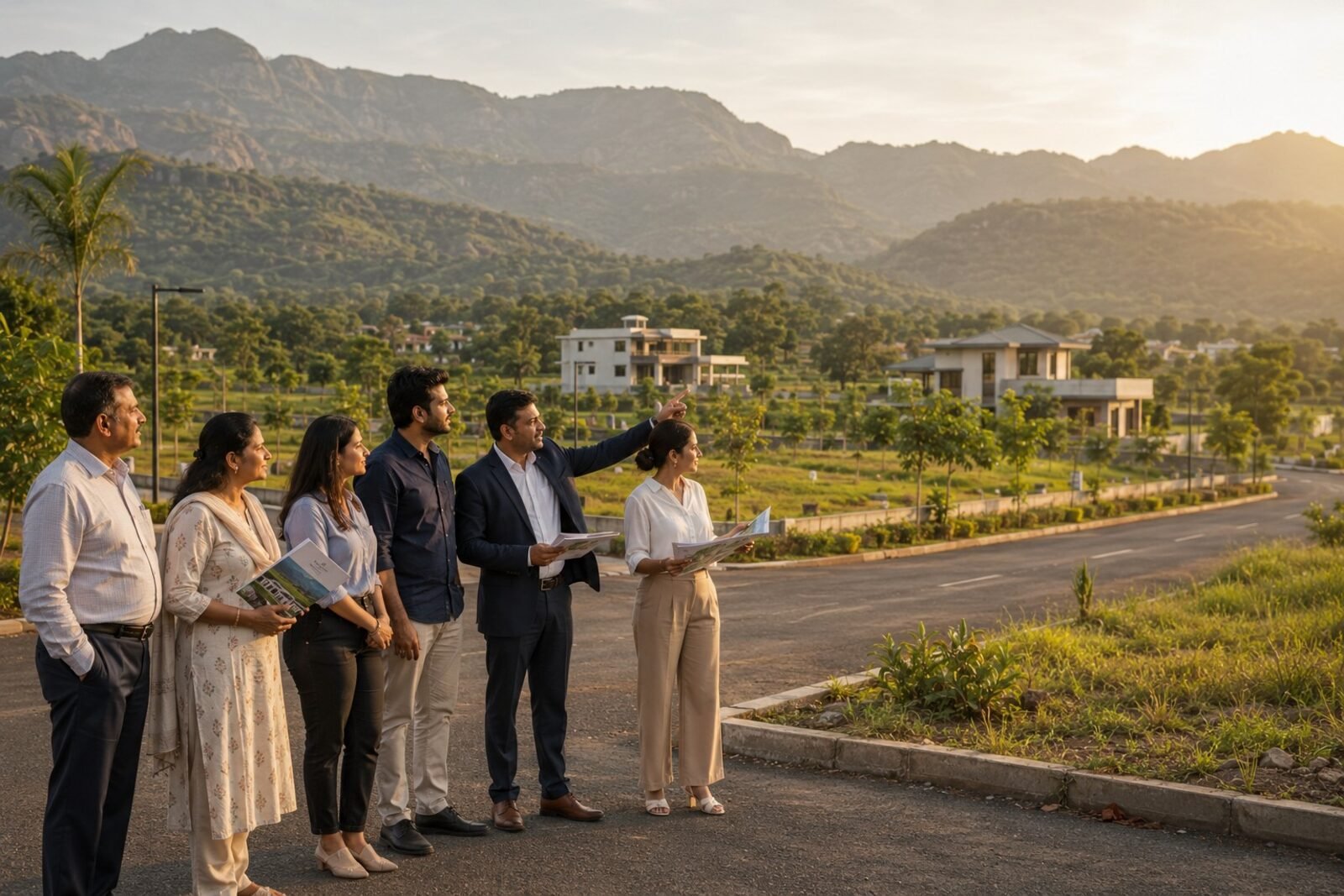
For most people, purchasing property is among the largest financial commitments they will ever make.
Yet many buyers spend months searching for the right property and only a few hours planning how they will actually finance it.
This often leads to unnecessary stress.
A well-planned budget does more than help you complete the purchase—it also ensures that owning the property remains comfortable for many years afterward.
Whether you are purchasing an NA plot, agricultural land, villa, farmhouse or apartment in Karjat, understanding the complete financial picture is just as important as understanding the legal documentation.
The Purchase Price Is Only One Part of the Total Investment
One of the most common mistakes first-time buyers make is treating the advertised property price as the total cost.
In reality, purchasing property usually involves several additional expenses.
These may include statutory charges, professional fees, documentation expenses, maintenance costs and future development expenditure depending upon the nature of the property.
Responsible buyers prepare for these costs before signing any agreement rather than discovering them afterwards.
A realistic financial plan creates confidence throughout the purchasing process.
Build a Budget Before You Begin Property Visits
Many buyers begin by visiting properties first and deciding their budget later.
Experienced buyers usually reverse this process.
Before visiting a single property, determine:
- Your maximum overall investment.
- How much you intend to pay from your own funds.
- Whether financing will be required.
- Your preferred repayment comfort level.
- Funds required for registration and statutory expenses.
- Emergency financial reserves after the purchase.
Having these answers prevents emotional decisions during site visits.
Never Stretch Your Budget to the Absolute Maximum
It is natural to feel tempted by a property slightly beyond your original budget.
Sometimes the difference appears manageable.
However, property ownership rarely ends on the day of registration.
Unexpected expenses can arise.
Repairs.
Boundary work.
Land development.
Interior work.
Landscaping.
Utility connections.
Maintenance.
Emergency repairs.
Leaving a financial safety margin often proves wiser than exhausting every available resource during the purchase.
Financial flexibility provides peace of mind long after the transaction is complete.
Consider Your Purpose Before Allocating Funds
Different objectives require different financial planning.
For example:
A family constructing a retirement home may need to reserve funds for future construction.
A second-home buyer should budget for periodic maintenance.
A developer may require capital for approvals, infrastructure and project execution.
An NRI should consider ongoing property management expenses.
The purchase budget should therefore align with the property's intended purpose rather than focusing only on acquisition.
Planning Construction Costs
Buyers purchasing land often concentrate entirely on the land price while overlooking future construction.
Building a home involves careful planning.
Construction costs vary depending on several factors, including:
- Architectural design.
- Quality of materials.
- Labour.
- Site conditions.
- Topography.
- Utilities.
- Interior specifications.
- Landscaping.
Instead of estimating casually, buyers should obtain realistic professional estimates before purchasing land intended for immediate development.
Understanding Ongoing Ownership Costs
Owning property involves recurring responsibilities.
Depending upon the property type, buyers may incur expenses relating to:
- Property maintenance.
- Security.
- Gardening and landscaping.
- Utility bills.
- Property taxes.
- Community maintenance charges.
- Repairs.
- Caretaking arrangements.
Ignoring these recurring costs often creates avoidable financial pressure later.
Financing Your Property Purchase
Some buyers purchase property entirely from personal savings.
Others choose financing through banks or financial institutions where applicable.
Before committing to any financing arrangement, carefully understand:
- Eligibility requirements.
- Repayment obligations.
- Interest structure.
- Processing timelines.
- Documentation requirements.
- Total financial commitment over the repayment period.
Borrow only within a repayment level that remains comfortable even if personal circumstances change.
Responsible borrowing supports long-term financial stability.
Avoid Making Decisions Based Solely on Tax Considerations
Some buyers begin their property search by asking only about tax benefits.
While taxation is certainly an important consideration, it should never become the primary reason for purchasing a property.
A fundamentally unsuitable property does not become suitable merely because certain financial benefits may be available.
Choose the right property first.
Understand taxation afterwards with appropriate professional advice.
Keep an Emergency Reserve
Financial planning should not end with registration.
Life is unpredictable.
Unexpected medical expenses.
Employment changes.
Business fluctuations.
Family commitments.
Natural events.
Maintaining an emergency financial reserve after purchasing property allows buyers to manage unforeseen situations without unnecessary pressure.
Experienced investors almost always preserve liquidity rather than investing every available rupee into one asset.
Think Long-Term, Not Just About Today's Budget
Property ownership often extends across decades.
During that time:
Family needs change.
Children grow.
Careers evolve.
Retirement approaches.
Infrastructure develops.
Neighbourhoods mature.
Your financial planning should therefore support not only today's purchase but tomorrow's lifestyle as well.
Ask yourself:
Will this property remain financially comfortable five years from now?
Ten years from now?
Twenty years from now?
Long-term affordability is often more important than short-term excitement.
Don't Forget Estate Planning
Many families purchase property intending to preserve wealth for future generations.
In such cases, it is sensible to think ahead.
Discuss succession planning with qualified professionals.
Maintain organised documentation.
Ensure ownership records remain updated.
Preserve copies of important documents securely.
Planning today can prevent confusion for family members many years later.
Financial Discipline Often Leads to Better Property Decisions
Interestingly, buyers with the strongest financial discipline often make the most confident purchasing decisions.
They:
Research thoroughly.
Avoid unnecessary pressure.
Maintain realistic budgets.
Verify documentation carefully.
Retain emergency reserves.
Seek professional advice when required.
Their objective is not merely to buy property.
It is to own property comfortably and responsibly.
How Dream Homes By Rahul Gargatte Helps Buyers Make Financially Informed Decisions
At Dream Homes By Rahul Gargatte, we believe financial planning should begin before selecting a property.
Understanding a buyer's budget, long-term objectives and intended use allows us to recommend opportunities that genuinely align with their circumstances rather than encouraging unnecessary financial strain.
Alongside our experienced in-house legal professionals and property experts, we also help buyers understand the broader financial implications of ownership, documentation requirements and practical considerations associated with different property types.
Our goal is to help buyers invest with confidence, clarity and long-term financial comfort—not simply complete a transaction.
Financial Planning Checklist Before Purchasing Property
Before signing any agreement, ask yourself:
- Have I calculated the complete cost of ownership?
- Have I planned for registration and statutory expenses?
- Have I budgeted for maintenance and future development?
- Have I retained an adequate emergency reserve?
- Have I understood my financing obligations, if applicable?
- Can I comfortably afford this property over the long term?
- Have I consulted experienced financial and legal professionals where necessary?
- Am I purchasing within my means rather than stretching beyond my comfort level?
A well-chosen property can become a valuable long-term asset.
A well-planned financial strategy helps ensure that ownership remains enjoyable rather than stressful.
Registration Process: What Happens After You Decide to Buy a Property in Karjat?
Finding the right property is only the beginning of the journey.
The actual purchase process involves several important legal and administrative steps that should never be rushed.
Many first-time buyers become so focused on selecting the property that they pay very little attention to what happens between agreeing on the purchase and becoming the legal owner.
That period is extremely important.
A well-managed transaction protects both the buyer and the seller by ensuring that documents are properly verified, agreements are clearly understood and legal formalities are completed in accordance with applicable laws.
This chapter provides a practical overview of the typical purchase process. Since every property transaction is unique, buyers should always seek independent legal and financial advice appropriate to their specific circumstances.
Step 1: Final Property Evaluation
Before making any financial commitment, complete your evaluation.
This includes:
- Visiting the property personally.
- Reviewing available documentation.
- Understanding the surrounding locality.
- Verifying accessibility.
- Evaluating practical suitability.
- Clarifying any unanswered questions.
Do not allow excitement or urgency to replace careful evaluation.
Once you are satisfied that the property aligns with your objectives, you can proceed to the next stage.
Step 2: Document Verification
This is one of the most important stages of the transaction.
Before paying any substantial amount, buyers should independently verify the available documentation relating to:
- Ownership.
- Title history.
- Survey details.
- Applicable approvals.
- Land classification.
- Access.
- Revenue records.
- Encumbrances where applicable.
- Other relevant documents based on the property's nature.
If additional clarification is required, obtain it before moving forward.
Questions become much easier to resolve before registration than afterwards.
Step 3: Understanding the Terms of the Transaction
Every buyer should clearly understand:
- Purchase consideration.
- Payment schedule.
- Documents being transferred.
- Timeline for completion.
- Responsibilities of both parties.
- Possession arrangements.
- Any agreed conditions.
Never rely upon verbal understandings alone.
Important terms should always be properly documented.
Step 4: Agreement Between the Parties
Depending upon the transaction, buyers and sellers may execute appropriate agreements before the final sale deed is registered.
Every agreement should be read carefully.
Do not hesitate to ask questions if any clause is unclear.
Understanding the agreement today is considerably easier than resolving misunderstandings later.
Independent legal advice is always advisable before signing any binding document.
Step 5: Arranging Finance (If Applicable)
If financing is required, buyers should coordinate with the chosen financial institution well before the proposed registration date.
Understand:
- Documentation requirements.
- Processing timelines.
- Disbursement procedures.
- Conditions attached to financing.
Delays often occur simply because financial arrangements were started too late.
Planning ahead helps ensure a smoother transaction.
Step 6: Payment Through Proper Banking Channels
Property transactions should always follow applicable legal and banking requirements.
Maintain proper records of every payment.
Preserve:
- Bank statements.
- Payment acknowledgements.
- Receipts.
- Supporting correspondence.
- Transaction references.
Good record-keeping protects both parties and simplifies future reference if required.
Step 7: Registration of the Sale Deed
The registration of the Sale Deed is one of the most significant stages in the property purchase process.
In Maharashtra, property transactions that are legally required to be registered are completed through the office of the Department of Registration and Stamps, Government of Maharashtra, subject to applicable laws and procedures.
Registration creates an official public record of the transaction.
Before registration, ensure:
- The Sale Deed accurately reflects the agreed terms.
- Property details match supporting documents.
- Survey numbers and measurements are correct.
- Names and identity details are accurate.
- All parties clearly understand the document before signing.
Never sign any document that you have not fully read or understood.
Step 8: Payment of Stamp Duty and Registration Charges
Certain property transactions require payment of stamp duty and registration charges in accordance with applicable laws.
These statutory charges are governed by the Government of Maharashtra and may change from time to time.
Rather than relying on outdated information or verbal estimates, buyers should always verify the applicable rates through official government sources or qualified professionals at the time of purchase.
Planning for these expenses in advance prevents last-minute financial surprises.
Step 9: Taking Possession
Possession is more than simply receiving the keys.
Where applicable, buyers should ensure they receive:
- Original documents agreed under the transaction.
- Possession letter, where relevant.
- Keys and access devices.
- Utility-related information.
- Society documents, if applicable.
- Other agreed records.
Before taking possession, inspect the property once again.
Confirm that the property corresponds to what was agreed during the transaction.
Step 10: Preserve Every Original Document
Once the purchase is complete, carefully organise and preserve all important documents.
Maintain both physical and digital copies wherever appropriate.
Store records securely.
Important documents may be required in the future for:
- Loans.
- Resale.
- Family succession.
- Taxation.
- Development.
- Legal verification.
Good record management is an important part of responsible property ownership.
Keep Your Revenue and Ownership Records Updated
After the transaction, certain records may require updating in accordance with applicable procedures.
Depending on the nature of the property, buyers should understand:
- Revenue record updates.
- Mutation procedures.
- Property tax records.
- Utility transfers.
- Society records, where applicable.
Completing these formalities promptly helps ensure that public records accurately reflect ownership.
Do Not Ignore Professional Advice After Registration
Some buyers assume that professional guidance is no longer necessary after registration.
In reality, post-purchase compliance is equally important.
Questions relating to construction, future development, taxation, succession planning or additional documentation may arise long after the transaction is complete.
Maintaining organised records and consulting experienced professionals whenever required continues to be beneficial throughout ownership.
How Dream Homes By Rahul Gargatte Supports Buyers Throughout the Purchase Journey
Purchasing property involves much more than identifying a suitable location.
At Dream Homes By Rahul Gargatte, we guide buyers through the entire journey—from the initial property search to understanding documentation, coordinating due diligence with our experienced in-house legal professionals and property experts, reviewing available records, and helping clients navigate the purchase process with greater clarity.
Our advisory approach focuses on ensuring that buyers understand every important stage before making financial commitments.
We believe that informed buyers make confident owners.
Rather than creating unnecessary urgency, we encourage careful planning, transparency and well-informed decision-making throughout the transaction.
Registration & Purchase Checklist
Before considering your purchase complete, ask yourself:
- Have I independently verified every important document?
- Have I fully understood the Sale Deed before signing?
- Have I confirmed the property's measurements and survey details?
- Have I maintained records of every payment?
- Have I verified the applicable stamp duty and registration requirements?
- Have I received all agreed original documents?
- Have I completed the necessary post-registration formalities?
- Have I safely preserved both physical and digital copies of important records?
Purchasing property is not just about completing a transaction.
It is about establishing secure ownership that provides confidence and peace of mind for many years to come.
Frequently Asked Questions About Buying Property in Karjat
After interacting with families, NRIs, first-time buyers, investors and developers over the years, we have noticed that many people ask similar questions before making a property purchase.
Some questions relate to legal documentation.
Others concern investment potential, infrastructure, construction or long-term ownership.
Rather than relying on rumours, social media discussions or incomplete information, we encourage buyers to ask questions, verify facts and seek clarity before making financial commitments.
The following questions are among the most common ones we encounter.
1. Is Karjat a Good Place to Buy Property?
Karjat has attracted sustained interest from homebuyers, second-home seekers, investors and developers because it combines natural surroundings with connectivity to the Mumbai Metropolitan Region.
However, whether it is the right place for you depends on several factors, including:
- Your objective.
- Your budget.
- The exact location.
- The property's documentation.
- Your intended holding period.
There is no universal answer.
The right property is one that aligns with your personal requirements rather than current market sentiment.
2. Is Every Property in Karjat a Good Investment?
No.
Every property should be evaluated individually.
Two properties located only a few kilometres apart may differ significantly in terms of:
- Documentation.
- Accessibility.
- Planning regulations.
- Ownership history.
- Surrounding development.
- Future usability.
Avoid judging an entire region based on one attractive property—or rejecting it because of one unsuitable property.
3. Should I Buy Land or a Ready Villa?
That depends entirely on your objectives.
If you enjoy designing and constructing your own home, a properly verified NA plot may suit your plans.
If you prefer immediate use with fewer construction-related responsibilities, a ready villa may be more appropriate.
Neither option is universally better.
The decision should reflect your lifestyle, budget and long-term plans.
4. Can I Build Immediately After Purchasing Land?
Not necessarily.
Construction depends upon several factors, including applicable planning regulations, approvals, permissions and the nature of the land.
Buyers should never assume that purchasing land automatically permits immediate construction.
Always verify applicable legal requirements before making plans.
5. What Documents Should I Verify Before Buying?
Documentation requirements vary depending upon the property's nature.
Commonly reviewed documents may include:
- Registered Sale Deed.
- Previous Title Documents.
- Revenue Records.
- Mutation Entries.
- Survey Records.
- Property Card where applicable.
- NA Order where applicable.
- Approved Plans where applicable.
- Tax Records.
- Identity verification of the seller.
- Other property-specific documents.
Independent legal verification is always advisable.
6. Should I Visit the Property More Than Once?
Yes.
Whenever practical, visit the property multiple times.
Ideally:
- Weekday.
- Weekend.
- Different times of the day.
- During the monsoon if possible.
Multiple visits provide a much more realistic understanding of accessibility, surroundings and neighbourhood activity.
7. Is Railway Connectivity Important?
For many buyers, yes.
Railway connectivity can improve convenience for:
- Daily commuting.
- Weekend travel.
- Senior citizens.
- Students.
- Visitors.
However, its importance depends upon your individual lifestyle and travel requirements.
8. How Important Is Road Access?
Road access is extremely important.
Beautiful land becomes significantly less practical if legal or physical access creates difficulties.
Always verify:
- Road width.
- Surface condition.
- Year-round usability.
- Legal access rights.
The final few hundred metres often matter just as much as the highway journey.
9. Should I Buy Solely Because Infrastructure Is Improving?
No.
Infrastructure should be viewed as one factor among many.
Responsible buyers also evaluate:
- Documentation.
- Ownership.
- Accessibility.
- Practical usability.
- Planning regulations.
- Long-term objectives.
Infrastructure alone should never determine a purchasing decision.
10. Is Agricultural Land the Same as NA Land?
No.
These are different categories of land.
Each may involve different legal requirements, permitted uses and documentation.
Buyers should clearly understand the applicable classification before proceeding.
Never assume that neighbouring properties have identical legal status.
11. Should NRIs Follow a Different Buying Process?
The legal framework applicable to property ownership should always be understood carefully by NRIs.
Additionally, overseas buyers often require:
- Reliable documentation.
- Independent verification.
- Secure record management.
- Property management planning.
- Trusted professional guidance.
Purchasing from another country requires additional attention to detail.
12. Is a Beautiful Location Enough?
No.
A property's appearance should never outweigh:
- Legal clarity.
- Accessibility.
- Documentation.
- Practical suitability.
- Long-term maintenance.
The best purchases combine attractive surroundings with strong fundamentals.
13. How Long Should Due Diligence Take?
There is no fixed timeline.
Complex transactions naturally require more detailed verification than straightforward purchases.
Buyers should never rush due diligence simply to meet an artificial deadline.
A carefully verified purchase is generally preferable to a hurried one.
14. Should I Trust Online Property Advertisements?
Online listings are useful starting points.
However, they should never replace:
- Personal visits.
- Independent verification.
- Documentary review.
- Professional advice.
Treat advertisements as introductions—not conclusions.
15. Is It Safe to Pay a Booking Amount Before Verification?
Generally, buyers should understand exactly what they are committing to before making financial payments.
Documentation should always receive appropriate attention before significant commitments are made.
Independent legal advice is advisable whenever uncertainty exists.
16. Should I Verify Every Original Document?
Yes.
Where relevant, original documents should be examined and independently verified.
Photocopies, scanned copies and photographs should not become substitutes for proper verification.
17. Can Google Maps Confirm Property Boundaries?
No.
Google Maps is an excellent navigation tool.
It is not an official record of legal property boundaries.
Survey records and official land documents should always be relied upon for boundary verification.
18. Can I Depend Solely on Verbal Assurances?
No.
Regardless of who provides the information, important statements should always be supported by documentary evidence wherever possible.
Good property decisions are based upon evidence rather than assumptions.
19. Should I Consult Professionals Before Buying?
Yes.
Property purchases often involve legal, technical, financial and practical considerations.
Depending on the property, buyers may benefit from consulting:
- Legal professionals.
- Chartered accountants.
- Surveyors.
- Architects.
- Property advisors.
Professional guidance frequently helps identify issues that first-time buyers may overlook.
20. How Can Dream Homes By Rahul Gargatte Help?
At Dream Homes By Rahul Gargatte, we believe buying property should be an informed and transparent process—not one driven by pressure or speculation.
Whether you are a first-time buyer, NRI, investor, family or developer, we help you understand the property beyond its photographs and marketing brochure.
Working with our experienced in-house legal professionals and property experts, we assist buyers in:
- Identifying suitable opportunities.
- Understanding documentation.
- Coordinating structured due diligence.
- Reviewing available records.
- Evaluating practical suitability.
- Understanding location-specific considerations.
- Supporting informed decision-making before financial commitments are made.
Our objective is simple:
To help you purchase property with confidence, clarity and complete peace of mind.
Final Thoughts Before You Begin Your Property Journey
Buying property in Karjat should never be viewed as a race.
The buyers who usually make the strongest decisions are not the fastest.
They are the most informed.
They ask questions.
They verify documents.
They visit multiple times.
They understand the locality.
They seek professional guidance.
Most importantly, they purchase only after they are satisfied that the property genuinely supports their long-term goals.
That approach may require a little more patience today.
But it often provides far greater peace of mind for many years to come.
Why Buyers Across Maharashtra Choose Dream Homes By Rahul Gargatte

Buying a property is rarely just about acquiring land or a home.
For many families, it represents years of savings.
For NRIs, it often reflects a lifelong connection with India.
For investors, it becomes part of a carefully planned financial strategy.
For developers, every acquisition forms the foundation of a future project.
Regardless of the purpose, one requirement remains constant.
Trust.
Trust in the documentation.
Trust in the advice being received.
Trust in the people guiding the transaction.
That is precisely where professional property advisory becomes valuable.
At Dream Homes By Rahul Gargatte, our objective has never been to simply sell property.
Our goal is to help buyers make informed, legally sound and well-researched property decisions.
We Believe Every Buyer Deserves Honest Advice
The real estate industry often focuses heavily on selling.
Large advertisements.
Limited-period offers.
Promotional campaigns.
Marketing promises.
While marketing has its place, we believe buyers deserve something even more valuable.
They deserve honest advice.
Sometimes the right recommendation is to proceed.
Sometimes the right recommendation is to wait.
Sometimes it is to reject a property altogether.
Protecting a buyer from making an unsuitable purchase is just as important as helping them complete a successful one.
That philosophy forms the foundation of our advisory approach.
Our Advisory Process Begins Before We Recommend Any Property
Every buyer has different priorities.
Some are searching for a peaceful retirement home.
Some want a secure investment.
Some are planning to build immediately.
Others intend to hold land for future generations.
Instead of recommending the same projects to everyone, we first understand:
- Why are you buying?
- What is your long-term objective?
- What type of property are you looking for?
- How frequently will you use it?
- What budget have you planned?
- What level of maintenance are you comfortable with?
Only after understanding these factors do we begin discussing suitable opportunities.
We Encourage Due Diligence—Not Impulse Buying
One of the principles we follow consistently is simple:
Never purchase a property because you feel pressured.
Take the time to:
- Visit multiple locations.
- Compare different options.
- Understand documentation.
- Ask questions.
- Verify information.
- Seek professional guidance.
If a property remains the right choice after careful evaluation, buyers naturally move forward with greater confidence.
That confidence is far more valuable than an impulsive decision.
Experienced In-House Legal Professionals and Property Experts
One of the most important advantages we offer is access to experienced in-house legal professionals and property experts who assist in coordinating structured due diligence.
Depending on the nature of the property, our team helps buyers understand available documentation relating to:
- Ownership history.
- Title documents.
- Revenue records.
- Land classification.
- Planning considerations.
- Access rights.
- Available approvals.
- Practical issues that deserve attention before purchase.
Rather than relying on assumptions, we encourage buyers to evaluate documentary evidence before making financial commitments.
Guidance for First-Time Buyers
Purchasing your first property can feel overwhelming.
There are unfamiliar documents.
Legal terminology.
Government departments.
Registration procedures.
Financial planning.
Construction considerations.
Our role is to simplify the process.
We explain every stage in clear language so buyers understand what they are signing, what questions they should ask and what records deserve attention.
An informed buyer is usually a confident buyer.
Special Assistance for NRIs
Buying property while living overseas presents additional challenges.
Travel is limited.
Time zones differ.
Document verification becomes more difficult.
Coordinating multiple professionals can be complicated.
We assist NRIs by helping coordinate structured due diligence, reviewing available documentation and providing practical guidance throughout the buying journey.
This allows overseas buyers to make informed decisions based on verified information rather than relying solely on online listings or promotional material.
Advisory Support for Investors
Every investor has different objectives.
Some prioritise capital preservation.
Others seek long-term appreciation.
Some focus on land banking.
Others evaluate future development opportunities.
Rather than recommending properties based on trends, we encourage investors to evaluate:
- Documentation.
- Accessibility.
- Market fundamentals.
- Long-term usability.
- Exit flexibility.
- Practical ownership considerations.
Investment decisions supported by research generally remain more resilient than those driven solely by market excitement.
Guidance for Builders and Developers
Developers require a different level of analysis.
Large land acquisitions involve considerably more than location.
Planning regulations.
Road connectivity.
Utilities.
Land aggregation.
Environmental considerations.
Development feasibility.
Documentation.
These aspects require structured evaluation before negotiations progress.
Our advisory approach helps developers understand available information before significant investments are made.
Transparency Is More Important Than Sales Pressure
We believe buyers appreciate transparency.
If additional verification is required, we say so.
If questions remain unanswered, we recommend obtaining clarification.
If more documentation is necessary, we encourage buyers to wait before making commitments.
This approach occasionally takes longer.
However, it often leads to stronger long-term relationships built on trust rather than urgency.
Our Commitment to Responsible Real Estate Advisory
At Dream Homes By Rahul Gargatte, we are committed to promoting responsible property ownership.
That means encouraging buyers to:
- Verify official records.
- Understand documentation.
- Visit properties personally.
- Evaluate surrounding infrastructure.
- Consider long-term ownership responsibilities.
- Seek professional advice whenever required.
We believe these practices benefit both buyers and the wider real estate industry.
Before You Invest, Let Us Help You Evaluate the Property
If you are considering purchasing:
- An NA Plot
- Agricultural Land
- A Farmhouse
- A Villa
- An Apartment
- A Second Home
- Development Land
- Investment Property
...we invite you to speak with us before making your final decision.
Share the available property details with our team, including, wherever applicable:
- Survey Number
- Village Name
- Google Location
- 7/12 Extract
- Property Card
- Sale Deed
- Layout Plan
- NA Order
- Brochure
- Available Approvals
- Any other relevant documentation
Our experienced in-house legal professionals and property experts will help coordinate a structured review of the available information, identify areas requiring further verification and help you understand important practical considerations before you proceed.
Let's Build Confidence Before You Build Your Future
A property can become one of your family's most valuable assets.
It can also become one of its biggest financial responsibilities.
The difference often lies in the decisions made before the purchase.
Take the time to verify.
Take the time to understand.
Take the time to ask questions.
Most importantly, take the time to make an informed decision.
If you would like professional guidance backed by careful research, structured due diligence and a commitment to transparency, Dream Homes By Rahul Gargatte would be honoured to assist you on your property-buying journey.
Because buying property is not just about finding land.
It is about building confidence for the future.
Final Thoughts: Buying Property in Karjat Is a Journey, Not Just a Transaction
If you have reached this point in the guide, you have already done something that many property buyers never do.
You have invested time in understanding the process before investing your money.
That single decision places you in a much stronger position than buyers who rely solely on advertisements, social media videos or verbal assurances.
Throughout this guide, we have explored Karjat from multiple perspectives—not just as a beautiful destination, but as a location where real people make important financial decisions.
We discussed geography, connectivity, lifestyle, infrastructure, legal due diligence, government authorities, documentation, financial planning, registration, different buyer profiles and the common mistakes that can affect long-term ownership.
One message has remained consistent throughout every chapter.
Good property decisions are rarely made in haste.
They are built on knowledge.
They are supported by documentation.
They are strengthened through verification.
And they are guided by patience.
Whether you are purchasing your very first property or expanding an existing portfolio, these principles remain the same.
There Is No Such Thing as the "Perfect" Property
Many buyers begin their search looking for perfection.
The perfect location.
The perfect price.
The perfect view.
The perfect investment.
In reality, every property involves trade-offs.
One location may offer excellent accessibility but smaller plot sizes.
Another may provide exceptional privacy but require additional travel.
One property may be ideal for retirement.
Another may suit long-term investment.
A third may be appropriate for future development.
The objective should never be to find a property that is perfect for everyone.
The objective is to find the property that is perfect for your goals, your family, your budget and your future plans.
That distinction often leads to better long-term satisfaction.
Knowledge Is One of the Best Investments You Can Make
Many people spend weeks negotiating price.
Very few spend the same amount of time understanding documentation.
Ironically, documentation often determines whether the purchase remains enjoyable years later.
The more informed you become, the more confident your decisions are likely to be.
Knowledge costs very little.
Correcting avoidable mistakes after purchasing property can cost significantly more.
Verify Before You Trust
One principle deserves repeating.
Whenever you hear an important statement about a property, ask yourself:
Can this be independently verified?
Whether the information relates to:
- Ownership.
- Future infrastructure.
- Planning permissions.
- Accessibility.
- Land classification.
- Development potential.
- Approvals.
- Measurements.
Always seek documentary evidence wherever possible.
Verification protects buyers.
It also protects honest sellers by ensuring transparency throughout the transaction.
Property Is More Than an Investment
Real estate is often discussed purely in financial terms.
Return on investment.
Future appreciation.
Market cycles.
Capital growth.
While these factors certainly matter, property often represents much more.
It becomes the place where children create memories.
Where parents retire peacefully.
Where families gather during holidays.
Where future generations inherit lasting assets.
The emotional value of a well-chosen property frequently extends far beyond financial calculations.
That is why careful decision-making deserves the time it requires.
Our Promise at Dream Homes By Rahul Gargatte
At Dream Homes By Rahul Gargatte, we believe every buyer deserves honest guidance, transparent communication and professional support throughout the property-buying journey.
Our role is not limited to introducing property opportunities.
We work to help buyers understand the complete picture before they invest.
Depending on your requirements, our experienced in-house legal professionals and property experts assist in coordinating structured due diligence, reviewing available documentation, understanding ownership records, evaluating practical considerations and helping you make informed decisions with greater confidence.
Whether you are searching for:
- Premium NA Plots
- Agricultural Land
- Farmhouses
- Villas
- Second Homes
- Investment Properties
- Development Land
- Boutique Residential Projects
our objective remains the same:
To help you purchase responsibly, confidently and with complete transparency.
Before You Purchase Any Property, We Invite You to Speak With Us
If you are currently evaluating a property anywhere in Karjat or the surrounding region, we encourage you to contact us before making your final commitment.
Even if you have already shortlisted a property, we can help you review the available information before you proceed.
Wherever applicable, you may share:
- Survey Number
- Village Name
- Google Maps Location
- 7/12 Extract
- Property Card
- Registered Sale Deed
- Mutation Entries
- Layout Plan
- NA Order
- MahaRERA Registration Number (where applicable)
- Brochure
- Photographs
- Any other available documentation
Our experienced in-house legal professionals and property experts will help coordinate a structured review of the available information, identify areas requiring further verification and assist you in understanding the property's documentation before you make a significant financial decision.
Contact Dream Homes By Rahul Gargatte
If you would like professional guidance regarding property in Karjat or other selected locations across Maharashtra, we would be delighted to assist you.
Dream Homes By Rahul Gargatte
Website: www.dreamhomesexclusive.com
WhatsApp / Mobile: +91 93269 25975
Whether you are a family, NRI, investor, builder or developer, our team is committed to helping you make informed property decisions through research, transparency and professional due diligence.
Disclaimer
This article has been prepared solely for educational and informational purposes.
Every effort has been made to ensure that the information presented was accurate and based on authentic and publicly available sources at the time of publication. However, government regulations, planning policies, taxation, infrastructure projects, land records, environmental regulations and legal requirements may change over time.
Readers should independently verify all property-specific information with the relevant government authorities, statutory bodies and qualified legal, financial, tax and technical professionals before making any investment or purchase decision.
Nothing contained in this article should be interpreted as legal, financial, taxation or investment advice, nor should it be considered a recommendation to purchase any specific property.
Property purchases involve financial risk, and every buyer's circumstances are unique.
Dream Homes By Rahul Gargatte, its representatives and contributors shall not be liable for any decisions made solely on the basis of this article without independent verification and appropriate professional advice.
Continue Learning
If you found this guide helpful, you may also enjoy reading our other in-depth educational articles on:
- Buying NA Plots in Maharashtra
- Agricultural Land Buying Guide
- Second Homes in Maharashtra
- Due Diligence Before Buying Property
- Understanding MahaRERA
- Property Registration Process
- NRI Property Buying Guide
- Investment Property Checklist
- Lonavala & Malavli Property Guide
- Igatpuri Second Home Guide
- Alibaug Property Investment Guide
Our goal is to build one of Maharashtra's most trusted knowledge resources for genuine property buyers through authentic, research-driven and educational content.
Thank you for reading.
We wish you every success in your property journey—and we hope that when the time comes to make one of life's biggest financial decisions, you choose knowledge, transparency and professional guidance above everything else.
— Dream Homes By Rahul Gargatte
End of the Complete Karjat Property Guide
Before You Buy in Karjat, Let Us Help You Verify It
Whether you are a family, an NRI, an investor or a developer, our advisory process begins with your requirements — not a sales pitch. Our in-house legal professionals and property experts help you review documentation, coordinate due diligence and understand a property's practical realities before you make one of life's biggest financial decisions.